Aim Trainer
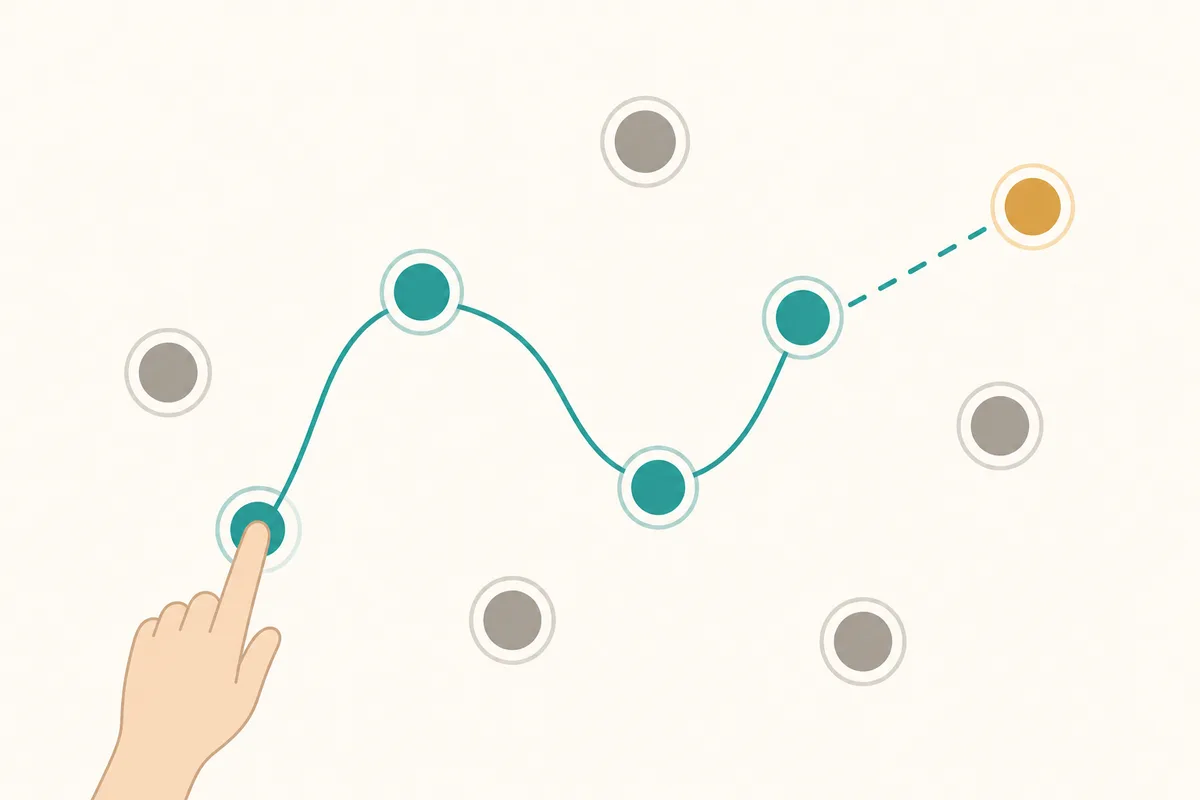
Hit thirty targets one at a time, with every movement timed and no pause between targets.
Settings
Changing one restarts the attempt, and scores set under different settings are not comparable.
Quick start
- 1Click Start. The first target appears straight away.
- 2Click it. The next appears instantly, somewhere else on the canvas.
- 3There is no waiting between targets. The clock never stops.
- 4A miss costs you time, because the target stays until you hit it.
- 5After thirty targets you get your middle time, your best, your worst and your misses.
Loading test
How you compare
Time per target (ms). Lower is faster. Reference distribution, not CognitiveDrill data.
The median for this test is 620 ms. Take a run and your score appears on the bar.
Reference distribution, not CognitiveDrill data. It is shaped to match published results for this task and is replaced by our own norms once a cohort reaches n = 1,000. Shape based on: Fitts PM.
Try next
About this test
Aiming with the waiting taken out
The gamer reaction test makes you wait for a target, so its score mixes reacting with moving. This one drops the wait completely. The next target appears the moment the last one dies, so the clock is measuring pointing and nothing else.
That makes it the cleaner measure of mouse control and the jumpier one to read, because the distance and angle to each target keep changing. Over thirty targets that evens out, which is why the run is not shorter.
Middle, best and worst, because the average lies
One average hides the thing that actually costs you in a game. That is the occasional 1,200 ms flail at a target in an awkward spot. So the card shows your middle time, your fastest and your slowest. The gap between your middle and your worst is the number worth watching.
Most of the pattern in your times is predictable. Far, small targets are slow. Near, large ones are fast. Size hurts you more than distance does.
If your worst time is more than double your middle one, the trouble is usually overshooting rather than raw speed. Slowing your first movement by ten per cent often improves the middle.
What this cannot practise
Clicking a still circle on a flat canvas is a sliver of what aiming in a game involves. There is no moving target to follow, no recoil, no strafing, no field of view, no sensitivity conversion and no crosshair placement. Those are what separate players who flick at the same speed.
There is also no evidence that browser aim practice carries over to any particular game, and we are not going to imply otherwise. Use it as a warm-up and a lap time. To train for a game, train in that game, or in a trainer built to match its sensitivity.
Settings that change the number
Target size moves scores a lot, so runs at different sizes cannot be compared. The reference distribution covers medium targets only.
Window size matters too. A bigger window means longer journeys, so a full-screen run on a large monitor gives slower times than the same run in a small window.
Sensitivity is yours to set, and it is the one most worth playing with. Very high sensitivity gets you there fast and makes correcting expensive. Very low sensitivity is slow but rarely misses. The best setting for most people sits lower than gaming folklore suggests, and this test is a cheap way to find yours.
For pure repetition speed with no aiming at all, see the click speed test. For population figures on a genuinely useful input skill, see average typing speed.
To separate the reacting from the pointing, take the gamer reaction test and subtract this score from it. What counts as a good reaction time explains why what is left over, rather than either total, is the number that says something about you.
Questions
What is a good time per target?
Around 620 ms at medium size is typical, and under 500 ms is quick. Only compare runs taken at the same target size and roughly the same window size.
Do misses count?
Yes. The target stays until it is hit, so a miss costs you time on that target, and the miss count is shown alongside your median.
Will this make me better at aiming in games?
It will make you better at clicking circles in a browser. Transfer to a specific game depends on sensitivity, field of view and mechanics this cannot reproduce, so treat it as unproven.
Why is my worst target so much slower than my median?
Usually overshoot. A movement that lands past the target needs a correction, and corrections are expensive. Starting slightly slower often lowers both numbers.
Does screen size affect the score?
Yes, because a larger canvas means longer average travel. Keep the browser window at a consistent size if you are comparing runs.
Sources
- Fitts PM (1954). The information capacity of the human motor system in controlling the amplitude of movement. Journal of Experimental Psychology, 47(6), 381-391. Link
- Elliott D, Helsen WF, Chua R (2001). A century later: Woodworth's (1899) two-component model of goal-directed aiming. Psychological Bulletin, 127(3), 342-357. Link