Sequence Memory Test
Repeat the sequence as it grows by one step after every correct attempt.
Settings
Changing one restarts the attempt, and scores set under different settings are not comparable.
Quick start
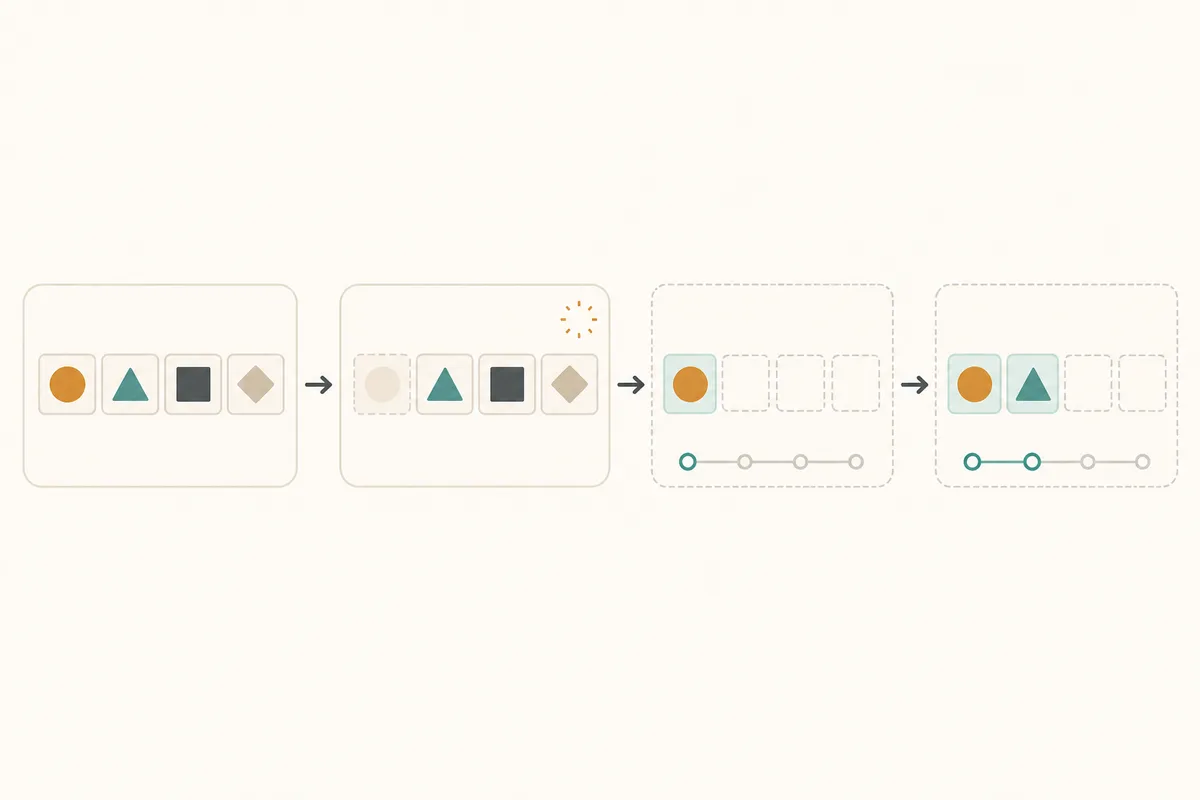
- 1Click Start. One square lights up.
- 2Click it. The sequence plays again with one new square on the end.
- 3Repeat the whole sequence from the beginning every round.
- 4One wrong square ends the run. There are no second chances here.
- 5Your score is the longest sequence you finished.
Loading test
How you compare
Sequence length (steps). Higher is better. Reference distribution, not CognitiveDrill data.
The median for this test is 9 steps. Take a run and your score appears on the bar.
Reference distribution, not CognitiveDrill data. It is shaped to match published results for this task and is replaced by our own norms once a cohort reaches n = 1,000. Shape based on: Miller GA.
Try next
About this test
The one-mistake rule
Most tests here give you two attempts at a length. This one gives you none, and that is what makes it feel different. One mistake ends the run. By round eight you are not only remembering. You are managing the risk of fumbling a step you already know.
That also makes the score jumpier than a span test, which is the trade. Expect a spread of two or three steps between runs on the same evening. The number worth keeping is your best of several, which is why the result card shows your record next to the current attempt.
Why repeating from the start matters
Every round replays the whole sequence, not just the new step. So the task rewards holding one steady picture of the lot, rather than keeping a rolling window of the last few. It is the same feature that made the electronic memory games of the late 1970s hard. It is also why nine steps feels far more than one step harder than eight.
The other consequence is that a slip anywhere kills the run. Attention tends to fail at the join between the part you have practised and the part you have just seen. That is why so many runs die on the second-to-last step rather than the last one.
Position, order, and what you are actually storing
This task joins two things the other memory tests keep apart. Corsi block tapping scatters its blocks so you cannot name them. Visual memory drops the order entirely. Sequence memory keeps place and order both, on a tidy grid. So most people quietly turn it into words or a rhythm: top left, centre, right, right again.
That is why scores here usually beat Corsi spans by several units. Your spatial memory did not improve between the two tabs. This layout simply lets you talk yourself through it, which Corsi is built to prevent. How working memory works goes into the two-system account behind the gap.
Practical notes
Grouping works and is expected. Splitting the sequence into runs of three, or humming it as a rhythm, will add steps to your score. So will pausing for a beat before you start clicking instead of rushing the first step.
Playback speed is a setting because it moves your score. Faster playback squeezes the sequence into a smaller window for repeating it back to yourself, and usually costs you a step or two. Runs at different speeds cannot be compared, and the reference distribution covers the standard speed only.
If you want the word-based equivalent, what counts as a good digit span is the place to start. It has a century of comparison data behind it.
Questions
What is a good sequence memory score?
Nine steps is around the middle of the reference distribution, eleven is good and thirteen or more is strong. Scores at non-standard playback speeds are not comparable.
Why is my score so much higher than my Corsi block span?
Because a regular grid lets you turn positions into words or rhythms, and Corsi's irregular layout is designed to stop exactly that.
Is it cheating to say the sequence out loud?
It is not cheating, but it changes what the test measures and it will push your score up. Keep the method fixed if you want your runs to be comparable.
Why does one mistake end the run?
Sudden death keeps runs short and makes the score easy to state. It does make the number noisier, which is why your personal best is shown next to the current attempt.
Does it help to close my eyes while the sequence plays?
No. The sequence is visual, so you need to watch it. Closing your eyes between rounds while you rehearse is a different matter and some people find it helps.
Sources
- Miller GA (1956). The magical number seven, plus or minus two: some limits on our capacity for processing information. Psychological Review, 63(2), 81-97. Link
- Cowan N (2001). The magical number 4 in short-term memory: a reconsideration of mental storage capacity. Behavioral and Brain Sciences, 24(1), 87-114. Link