Mental Math Test
Solve sums one at a time and see how many correct answers you can type in one minute.
Settings
Changing one restarts the attempt, and scores set under different settings are not comparable.
Quick start
- 1Pick your window and the sums you want.
- 2Press start. One sum appears, large, in the middle.
- 3Work it out. Type the answer into the box.
- 4Press enter or Go. The next sum arrives at once.
- 5Keep answering until the clock reaches zero.
Loading test
Why there is no comparison
Correct sums per minute (sums/min). Higher is better. No published distribution exists for this task.
Every other test here draws your score on a bar of published results. This one cannot. Nobody has measured enough people on this task to say what a typical result is, so a bar here would be a picture of a number we made up.
Numbers for this task do circulate. The ones we could find name no study and do not agree with each other. We would rather show you nothing than repeat one of those.
No published distribution, and not CognitiveDrill data either. Nobody has measured this task on a large enough sample to say what a typical result is, so this page shows your number and does not rank it. Our own norm is published once a cohort reaches n = 1,000.
Try next
About this test
You type the answer, so it has to exist before it appears
One sum sits in the middle of the canvas. Underneath it there is a box and a button, and that is the whole apparatus.
The answer is typed rather than chosen from a set of options. That is the decision this page is built on. Pick from four choices and the job changes from working a sum out to recognising the right one in a line-up. Recognising is easier and it is quicker, and a lot of it can be done by ruling the other three out. Neither of those is arithmetic.
Typing has a cost and the page does not hide it. Your fingers are inside the number, and a run taken on a phone will not match a run taken on a keyboard you know. That is a real limit on comparing yourself with anyone else. It is not a limit on comparing yourself with yourself, which is the comparison this site keeps saying is the useful one.
Answers are one to four digits and the box takes nothing else. A letter cannot be typed into it and neither can a minus sign, because no sum here has a negative answer.
Half of every run is built to be the harder half
A sum is not a fixed amount of work. Some arrive whole from memory and some have to be assembled, and the gap between those two is most of what this test measures.
So every run holds equal numbers of both, drawn from a bag rather than left to the shuffle. The result card times the harder half separately, and the two figures will not match.
Which sums count as harder is a rule rather than a feeling, and the rule is in the list below. It follows the oldest finding in this corner of the literature. Bigger numbers take longer, not because they are more complicated to look at, but because small sums are recalled and big ones are worked out. Adults still count on their fingers for some of these, silently and quickly.
The carrying is where working memory arrives, and it is the reason this page and the memory tests are talking about the same machinery. A carried ten has to be held while the next column is done. How working memory works is the longer version of what that holding costs.
- An addition counts as harder when the units add up to ten or more, so something has to be carried.
- A subtraction counts as harder when the units being taken away are the bigger ones, so something has to be borrowed.
- A multiplication or a division counts as harder when one side of it is seven or more.
The window is a choice because the score is a rate
You may take this over sixty seconds, ninety, or two minutes, and all three give a number that means the same thing.
That freedom comes from the shape of the score rather than from generosity. A rate is a count divided by the time it took. Clearing 30 in a minute and 60 in two minutes both read as 30 a minute. A raw count cannot do that. Its meaning is glued to the clock it was taken against. That is exactly why the digit symbol test fixes its window at ninety seconds and offers no choice.
The mix is the setting that does change the task. Adding and taking away is one test. Putting the tables in is another, and putting division in is a third. Compare a run against a run with the same mix, or you are comparing two different things and reading the difference as yourself.
Ninety seconds is the default because sixty is short enough that two lucky sums move the figure. Longer runs are steadier for the same reason more coin flips are.
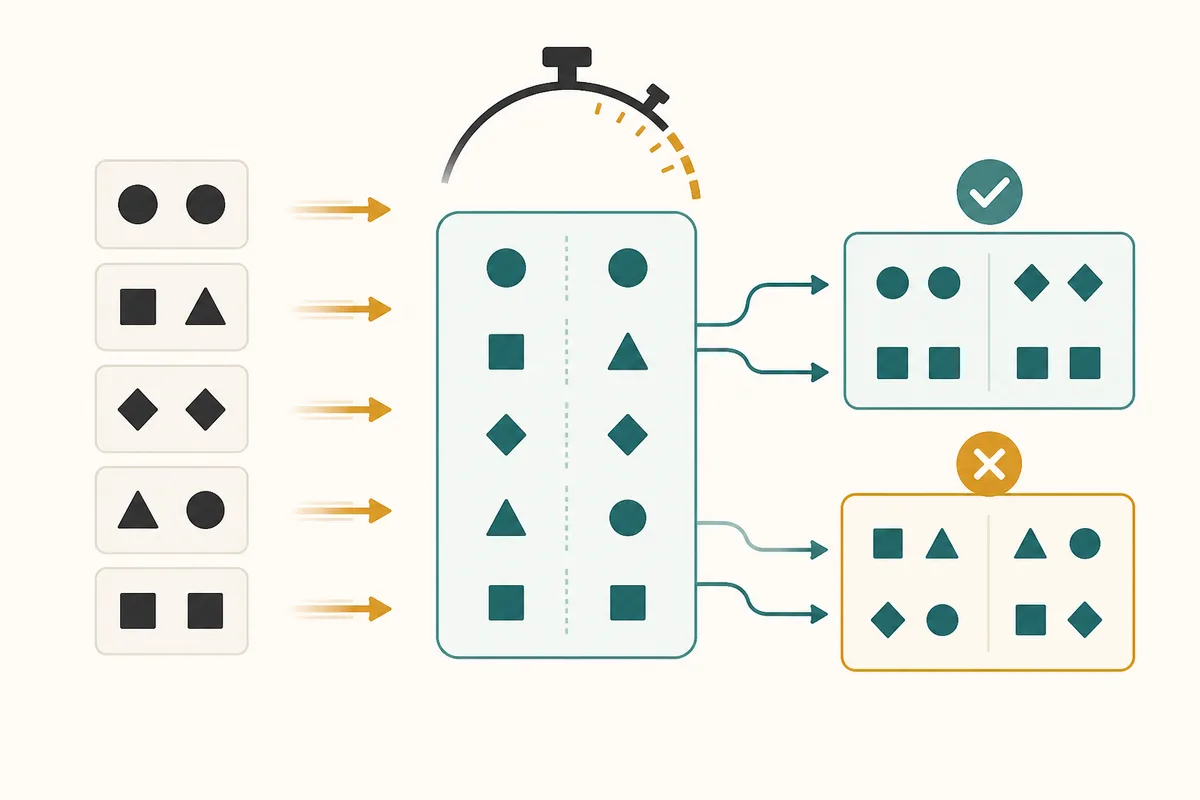
There is no league table for this, and that is not us being coy
The comparison block on this page draws no curve. No percentile, no band, no better than most.
Mental arithmetic has been measured for over a century and almost none of that measurement fits here. The published work times one sum at a time, to the millisecond. The point is to compare a small sum with a large one inside the same person. It reports the gap between conditions, which is a fact about arithmetic. It does not report how many sums a stranger clears in a minute on their own keyboard, which is a fact about a population.
Our number holds the mix of operations we chose, the window you chose and your typing. A curve lifted from a booth study would not contain any of those. It would look responsible and it would read as a fact. A person landing in the bottom quarter of a borrowed curve has been told something false about themselves.
So the page shows your number, your best and your own history, and says the ranking does not exist yet. Where a figure genuinely does sit against published data we say so and draw it. Processing speed by age is the honest example in this hub. It is a relative curve rather than an absolute one, for the same reason.
What a quick run here says about you
It says you recalled or worked out a set of small sums quickly, on this keyboard, today, with the mix you picked. That is the whole claim.
It is not a measure of how good you are at maths. Arithmetic under a clock is the smallest and most drilled corner of that subject. It says very little about whether you can set a problem up in the first place. Plenty of people who are excellent at mathematics are unremarkable here, and the reverse is common too.
Practise and the number will improve. What improves is this task. Getting quicker at two-digit addition makes you quicker at two-digit addition, and the honest evidence that it makes anything else better is thin.
The number moves with sleep, caffeine, the keyboard and how recently you did this. Repeat it under the same conditions to compare runs.
Questions
What is a good score on this test?
There is no published figure to quote, so any cut-off here would be made up. Most first runs on the default mix land somewhere between 15 and 35 sums a minute. Your own best over a few attempts is the comparison worth having.
Why do I type the answer instead of picking it?
Because picking is a different job. Given four options you can often rule three out without doing the sum, and the answer only has to be recognised rather than produced. Typing means the answer exists in your head before it exists on the screen.
Does my typing speed change my score?
Yes, and the result card says so. The clock runs while you type, so a slow keyboard costs you sums. Taking the typing back out would need a model of your hands, and that would be a guess sitting in the divisor of your score.
Which sums count as the harder ones?
An addition that carries, a subtraction that borrows, and any multiplication or division with a seven or more on one side. The split is fixed rather than random, so half of every run is drawn from that set and half is not.
Why can I choose the length of the run?
Because the score is a rate rather than a count. Thirty sums in a minute and sixty in two minutes both read as thirty a minute. So the window can be yours without the headline changing meaning. Longer runs are simply steadier.
Why does the page not compare me with other people?
Nobody has published a distribution for this. The measurements that exist time single sums in a laboratory to compare small ones with large ones. None of them counted how many sums a person clears in a minute at their own desk.
Will practising this make me better at maths?
It will make you quicker at these sums. That is worth having on its own and it is all we will claim. Arithmetic speed is a small corner of mathematics, and the evidence that drilling it improves the rest is weak.
Sources
- Ashcraft MH (1992). Cognitive arithmetic: A review of data and theory. Cognition, 44(1-2), 75-106. Link
- LeFevre JA, Sadesky GS, Bisanz J (1996). Selection of procedures in mental addition: Reassessing the problem size effect in adults. Journal of Experimental Psychology: Learning, Memory, and Cognition, 22(1), 216-230. Link
- Salthouse TA (1996). The processing-speed theory of adult age differences in cognition. Psychological Review, 103(3), 403-428. Link