Visual Memory Test
Study a flashing pattern and rebuild it as the grid grows after every correct answer.
Settings
Changing one restarts the attempt, and scores set under different settings are not comparable.
Quick start
- 1Click Start. A grid appears with some squares lit.
- 2Memorise which ones. The pattern stays on screen for two seconds.
- 3The pattern clears. Click every square that was lit, in any order.
- 4Get them all and you move up a level. Three mistakes end the run.
- 5Your score is the level you reached.
Loading test
How you compare
Visual memory level (levels). Higher is better. Reference distribution, not CognitiveDrill data.
The median for this test is 10 levels. Take a run and your score appears on the bar.
Reference distribution, not CognitiveDrill data. It is shaped to match published results for this task and is replaced by our own norms once a cohort reaches n = 1,000. Shape based on: Cowan N.
Try next
About this test
All at once, not one at a time
Every other memory test here feeds you information in an order. This one shows you everything at once, and that changes what is being measured. There is no sequence to repeat and no rhythm to lean on. You get a pattern. Either it fits in your visual memory or it does not.
That makes it a cousin of spot-the-difference experiments rather than of span tests. It also explains why people fall apart so suddenly. Going from eight lit squares to nine is not ten per cent harder. It is one step past a limit, and that limit is sharper than most people expect.
Why order does not matter here
You can click the lit squares in any order, and that is deliberate. Demanding a set order would sneak sequence memory into a test of pattern memory. The two really are separate skills. People who are excellent at sequence memory are often ordinary here, and the reverse happens just as often.
Each level is also all or nothing, again on purpose. Award part marks and clicking half the grid starts earning points. The question worth asking is whether the whole pattern survived, not how many lucky squares did.
The chunking escape hatch
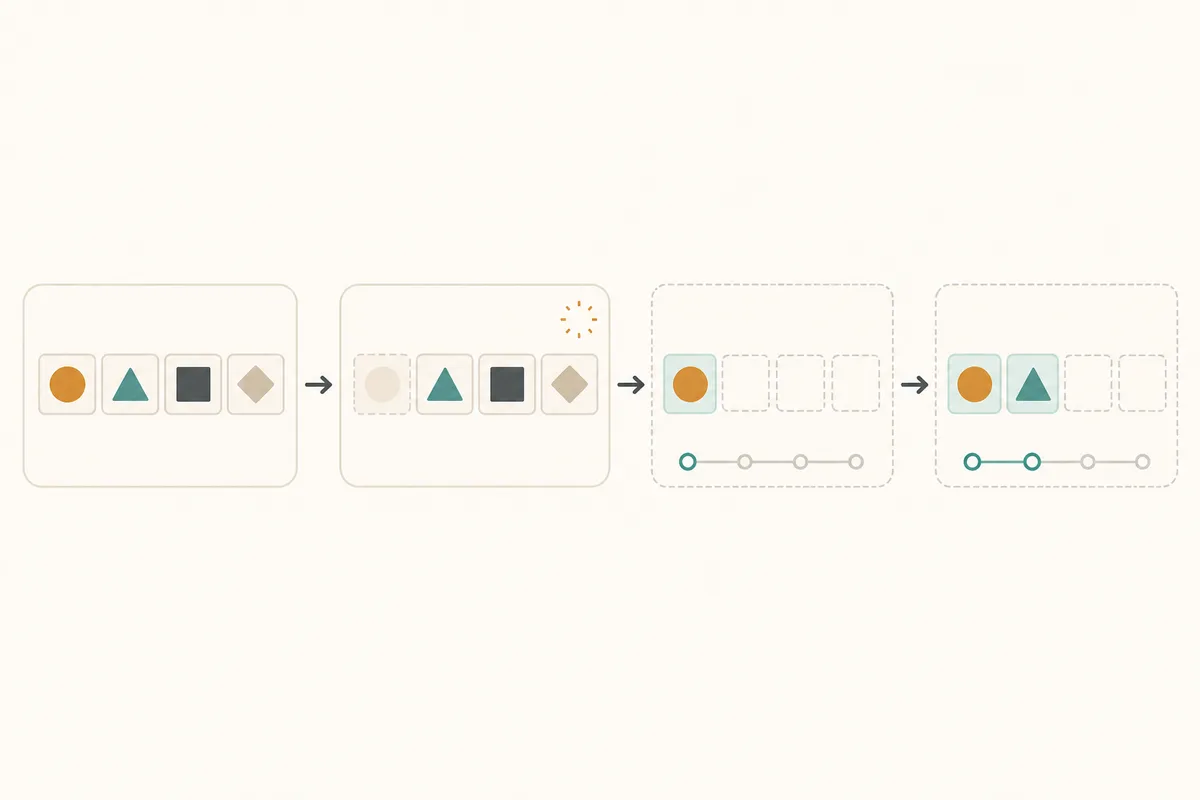
Almost everybody who does well here is doing something other than storing single squares. They read the pattern as a shape. They spot a symmetry. They split the grid into quarters and count each quarter. Or they name the shape after something it looks like.
This is not cheating. It is what visual memory does. Cowan's limit of about four items applies to items with nothing in common. A pattern that makes a recognisable shape counts as one item, not seven.
So if your score is climbing fast between runs, you are almost certainly getting better at grouping rather than holding more. How working memory works covers why that difference matters.
Reading your level
Level ten is around the middle of the reference distribution. Level fourteen is strong. The grid grows as you climb, so a level is not a fixed step of difficulty. Level twelve is harder than level ten, but by no defined amount.
Three lives per run also makes this score jumpier than a span test. One distracted level can cost you two or three. Take the middle of three runs if you want a number to keep.
Compare it against your digit span and Corsi results from the same sitting rather than against a stranger's screenshot. What counts as a good digit span explains why a span measures your technique as much as your capacity.
Questions
What is a good visual memory level?
Around level ten is typical, level twelve is good and level fourteen or above is strong. Levels are ordinal, so the gap between eleven and twelve is not the same size as the gap between six and seven.
Why do I lose three levels in a row after doing well?
Because the grid keeps growing while your capacity does not. The collapse is normal and it is roughly where the test intends to find you.
Does clicking order matter?
No. Any order counts, because requiring an order would turn a pattern-memory test into a sequence-memory test.
Is this the same as photographic memory?
No. Eidetic imagery in the popular sense is not an established adult phenomenon, and this test measures a capacity limit that everybody has.
Can I improve at it?
Yes, mainly by learning to see patterns as shapes rather than as collections of squares. That improvement is a strategy gain and does not transfer to unrelated memory tasks.
Sources
- Cowan N (2001). The magical number 4 in short-term memory: a reconsideration of mental storage capacity. Behavioral and Brain Sciences, 24(1), 87-114. Link
- Miller GA (1956). The magical number seven, plus or minus two: some limits on our capacity for processing information. Psychological Review, 63(2), 81-97. Link