Corsi Block-Tapping Test
Watch a sequence across nine blocks and tap it back in order without using words as a memory aid.
Settings
Changing one restarts the attempt, and scores set under different settings are not comparable.
Quick start
- 1Click Start. The blocks never move. Only their highlighting changes.
- 2Watch which blocks light up, and in what order. The first sequence is two blocks.
- 3Tap the same blocks back, in the same order.
- 4Get it right and the sequence grows by one. Fail twice at one length and the run ends.
- 5Your span is the longest sequence you got right.
Loading test
How you compare
Corsi block span (blocks). Higher is better. Reference distribution, not CognitiveDrill data.
The median for this test is 6 blocks. Take a run and your score appears on the bar.
Reference distribution, not CognitiveDrill data. It is shaped to match published results for this task and is replaced by our own norms once a cohort reaches n = 1,000. Shape based on: Corsi PM; Kessels RPC, van Zandvoort MJE, Postma A, Kappelle LJ, de Haan EHF; Berch DB, Krikorian R, Huha EM.
Try next
About this test
A board, a thesis, and one very influential patient
Philip Corsi built the first version at McGill in the early 1970s. Nine identical wooden blocks sat at scattered positions on a board. He tapped out a sequence and the volunteer tapped it back.
The scattered layout is deliberate. Blocks in a neat grid can be named by row and column. Once you can name them you can say them to yourself, and the test quietly turns into a word test.
Corsi worked alongside Brenda Milner, who studied the patient known as H.M. Their striking early finding was that block span and digit span could come apart. Damage could wreck one and leave the other untouched. That split is why the task still exists fifty years later.
Why your Corsi span is lower than your digit span
Words have a trick that positions do not. You can say a list of digits to yourself over and over, refreshing it faster than it fades. Now try that with 'third from the left, then bottom right, then middle'. There is no inner voice for places, and holding them in mind eats the attention the sequence itself needs.
So block spans usually land one to two units below digit spans in the same person. Comparing your result here with your digit span tells you more than either number alone. How working memory works explains the two-system idea that predicts the gap.
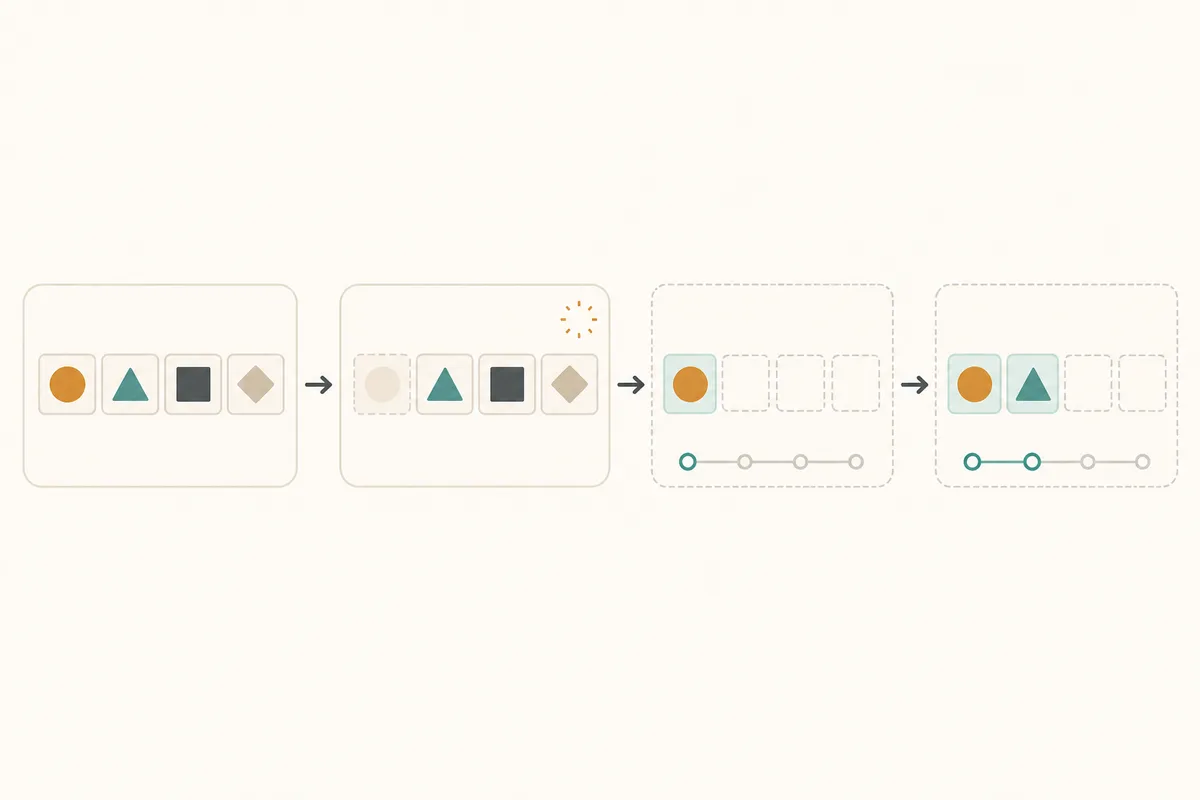
What a browser version can and cannot reproduce
Two things are lost on a screen. The real board is solid and you tap it with your hand, so your own movement helps you remember. And a real tester taps at a human rhythm rather than exactly once a second. Both changes make the screen version a little easier for some people and a little harder for others. Neither can be corrected.
What survives is the shape. This version uses the classic scattered nine-block layout rather than a grid, sized to fit the canvas, with blocks that never move between rounds. No sequence taps the same block twice in a row. Your taps only count once the sequence has finished playing, so an early tap cannot spoil a round.
Reading and comparing your score
Published figures, most usefully from Kessels and colleagues in 2000, put healthy adult block spans around five to six, with a fairly narrow spread. Do not drop a browser score straight into those tables. The speed, the screen size and the mouse all differ from the standard procedure. For the word-based comparison, what counts as a good digit span has the percentile picture.
Use your score as a lap time instead. Run it on the same device at the same time of day. Treat a change of one block as noise until several runs agree.
One last note on what this is not. It asks you to remember where things were. It does not ask you to rotate a shape or find your way anywhere.
Questions
What is a normal Corsi block span?
Healthy adults typically score around five or six blocks. Spans of four or seven are common and unremarkable. A single-block difference between runs is mostly noise.
Why are the blocks arranged so untidily?
An irregular layout stops you converting positions into words such as 'top row, second column'. A grid makes the task partly verbal, which defeats the purpose of a spatial span test.
Is Corsi span the same as visual memory?
No. Corsi measures memory for a sequence of locations. Remembering a whole pattern at once is a different task, closer to the visual memory test in this hub.
Does this work on a phone?
Yes, the blocks are touch targets and the layout scales. Expect a slightly different score from a mouse run, because tapping and pointing differ in timing.
Can I use it as a clinical spatial span score?
No. Clinical administration uses a physical board, a trained examiner and normative tables tied to that procedure. This is the same task, not the same instrument.
Sources
- Corsi PM (1972). Human memory and the medial temporal region of the brain. Doctoral dissertation, McGill University. Link
- Kessels RPC, van Zandvoort MJE, Postma A, Kappelle LJ, de Haan EHF (2000). The Corsi Block-Tapping Task: standardization and normative data. Applied Neuropsychology, 7(4), 252-258. Link
- Berch DB, Krikorian R, Huha EM (1998). The Corsi block-tapping task: methodological and theoretical considerations. Brain and Cognition, 38(3), 317-338. Link