Paper Folding Test
Follow a folded sheet as it is punched, then mark every hole that will appear when the sheet opens again.
Settings
Changing one restarts the attempt, and scores set under different settings are not comparable.
Quick start
- 1Press Play now. A strip of pictures shows a sheet being folded.
- 2Read the strip from left to right. The last picture holds the punch.
- 3Tap every square of the blank sheet that will have a hole in it.
- 4Tap a square again to take that hole back out.
- 5Press Open it out. Ten sheets, and nothing on a clock.
Loading test
Why there is no comparison
Holes in the wrong place (holes). Lower is faster. No published distribution exists for this task.
Every other test here draws your score on a bar of published results. This one cannot. Nobody has measured enough people on this task to say what a typical result is, so a bar here would be a picture of a number we made up.
Numbers for this task do circulate. The ones we could find name no study and do not agree with each other. We would rather show you nothing than repeat one of those.
No published distribution, and not CognitiveDrill data either. Nobody has measured this task on a large enough sample to say what a typical result is, so this page shows your number and does not rank it. Our own norm is published once a cohort reaches n = 1,000.
Try next
About this test
What one fold does to one hole
Fold a sheet of paper in half, punch a hole through it, then open it out. There are two holes, not one.
The second one sits at the mirror of the first, and the crease is the mirror line. That is the whole rule of this task, applied over and over.
Fold twice and the punch passes through four layers, so four holes appear. Fold three times and it passes through eight.
Every fold on this page is a fold in half, so every fold doubles the layers and doubles the holes. The strip of pictures shows each one as it happens.
The sheets are drawn at one scale, which is why they shrink across the strip. The size of the last picture tells you how much paper the punch went through.
A sheet folded three times really is an eighth of the one it started as. That is not a drawing trick, it is what folding does.
Why the score counts holes and not sheets
The headline is the number of holes you put in the wrong place, averaged over the ten sheets. Lower is better and zero is a clean run.
A mark out of ten would have thrown most of the run away. A deep sheet carries eight holes, and marking seven of them plus one stray would score the same as marking nothing at all.
Those are not the same performance. The gap between them is where most people who find this hard actually sit, so the score keeps it.
The card splits your number into the two ways of being wrong. One is holes you missed, the other is holes you added that were never there.
They add up to the headline, so you can see which way you go wrong. Missing holes usually means you stopped unfolding early. Adding them usually means you mirrored a fold that was not there.
There is one more thing the format buys. The sheet has sixteen squares to mark, so nothing on this page can be guessed. A version that offered five finished pictures would put a floor of twenty per cent under everybody.
The layers are the hard part, not the drawing
Nothing here is hard to see. The pictures are small and plain, and no square is hidden behind another one.
What runs out is the bookkeeping. Three folds put eight sheets of paper under the punch, and eight positions to work out on the way back.
Most people undo the folds one at a time, in the reverse order to the one they were made in. Each undo doubles what you are carrying.
So the task is really a question about how much you can hold while doing something else to it. The same shortage turns up when people hold digits, and the sizes are in the same range: see what counts as a good digit span.
The mechanism behind both is described in how working memory works, which is worth reading before deciding that a low score here means anything wider.
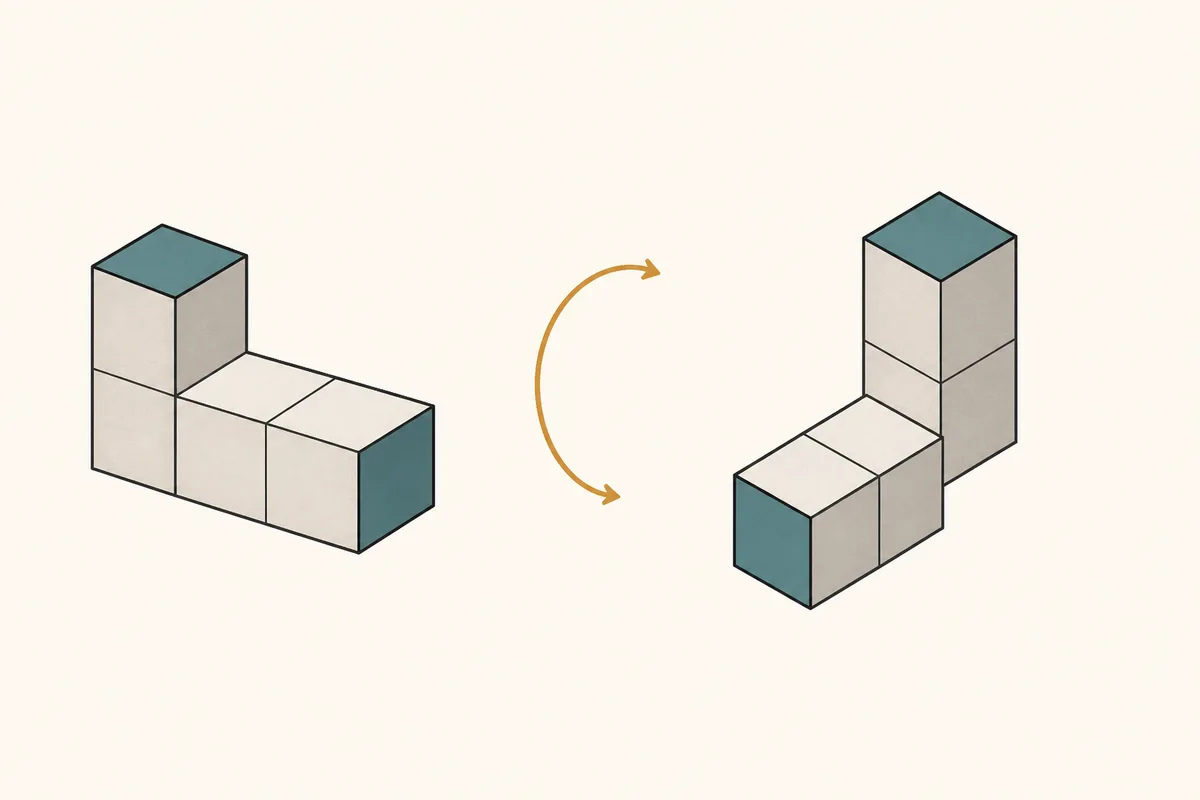
This is not the cube net puzzle
There is a second folding task that gets called by the same name, and it measures something else.
It shows a flat cross of six squares, the shape a cube makes when it is opened out. Two of its edges carry an arrow, and the question is whether the arrows meet once the cross folds back up.
Shepard and Feng timed that task in 1972, and the answer took longer the more squares had to come along in the fold.
Timing an answer that way is how the turning task next door is measured too. The line it produces is in mental rotation accuracy by angle.
That question has two answers, yes and no, and half of them can be had by tossing a coin. This one has a pattern of holes, and a pattern can be marked square by square and scored the same way.
So the punched holes version is the one on this page. If you came looking for the cube net task, one form of it is an item on the mixed spatial paper. Four sheets are offered there and exactly one of them closes.
Why there is no bar under your number
Most pages on this site put your result on a curve and tell you where it sits. This one shows the number on its own, and the reason is worth stating.
The paper test this comes from is VZ-2, from a 1976 manual of research tests. It gives twenty items with five finished pictures each, under a three minute clock, and it is scored as a mark out of twenty.
Its norm tables exist. They describe a different answer format, a different item count and a scoring rule with a correction for guessing built into it.
A mark on that test is not an error count on this one. Stretching one to look like the other would be an invented figure wearing a real citation, so the page says there is no comparison yet.
That changes once enough runs have been recorded here. The bar appears when a cohort reaches a thousand results, and not one run before that.
Questions
What is a paper folding test?
A test of spatial visualisation. You see a sheet folded a few times and punched, and you work out where the holes fall once it is opened out. It has been used in research batteries since the 1970s.
What is a good paper folding test score?
On this page a good result is a small number, because the number counts holes in the wrong place. Nobody has published a distribution for it, so the page will not tell you what is typical.
How many holes am I supposed to mark?
That is part of the puzzle. A punch through four layers of paper makes four holes, so the count follows from how many times the sheet was folded.
Why do the sheets get smaller across the strip?
Because they are all drawn at the same scale. A sheet folded three times really is an eighth of the one it started as, so its size tells you how many layers there are.
Is this the same thing as the punched holes test?
Yes. Punched holes is the other common name for this task, and it describes the same sheet, the same folds and the same question.
Is this the cube net folding test?
No. That one folds a flat cross into a cube, and this page does not run it. The mixed spatial paper does ask which of four sheets closes into a cube.
Does practising this make me better at it?
At this task, yes, and fairly quickly. Whether it improves anything outside the task is contested, and the meta-analytic answer is that gains rarely travel far.
Can I use this to prepare for an aptitude test?
For the folding items, yes. A full spatial paper also asks about rotation, cross-sections and assembly, and only the first of those has a page here so far.
Sources
- Ekstrom RB, French JW, Harman HH, Dermen D (1976). Manual for Kit of Factor-Referenced Cognitive Tests. Princeton NJ: Educational Testing Service. Paper Folding is test VZ-2. Link
- Shepard RN, Feng C (1972). A chronometric study of mental paper folding. Cognitive Psychology, 3(2), 228-243. Link
- Sala G, Aksayli ND, Tatlidil KS, et al. (2019). Near and far transfer in cognitive training: a second-order meta-analysis. Collabra: Psychology, 5(1), 18. Link