Attention to Detail Test
Compare two columns of codes and find the eight mismatched rows without a clock rushing your work.
Settings
Changing one restarts the attempt, and scores set under different settings are not comparable.
Quick start
- 1Click Start. A sheet of reference codes opens, an original beside each copy.
- 2Read across each row. The copy on the right should match the original on the left.
- 3Click any row where the two differ. Click it again to unmark it.
- 4Eight rows differ. There is no clock, so take as long as you need.
- 5Press Check the sheet. Every miss is shown before your score appears.
Loading test
How you compare
Differences found (items). Higher is better. Reference distribution, not CognitiveDrill data.
The median for this test is 6 items. Take a run and your score appears on the bar.
Reference distribution, not CognitiveDrill data. It is shaped to match published results for this task and is replaced by our own norms once a cohort reaches n = 1,000. Shape based on: Treisman AM, Gelade G; Wolfe JM; Healy AF.
Try next
About this test
Why one wrong character survives a proofread
Your eye does not read a reference code the way it reads a sentence. It lands on the code once or twice, takes a rough shape, and moves on. That is fast, and it is usually right, because nearly every code you check is correct.
A single wrong character does not disturb that shape. QK-48317-RM and QK-48371-RM are the same width, start the same way and end the same way. Nothing about the second one asks to be looked at, so nothing looks at it.
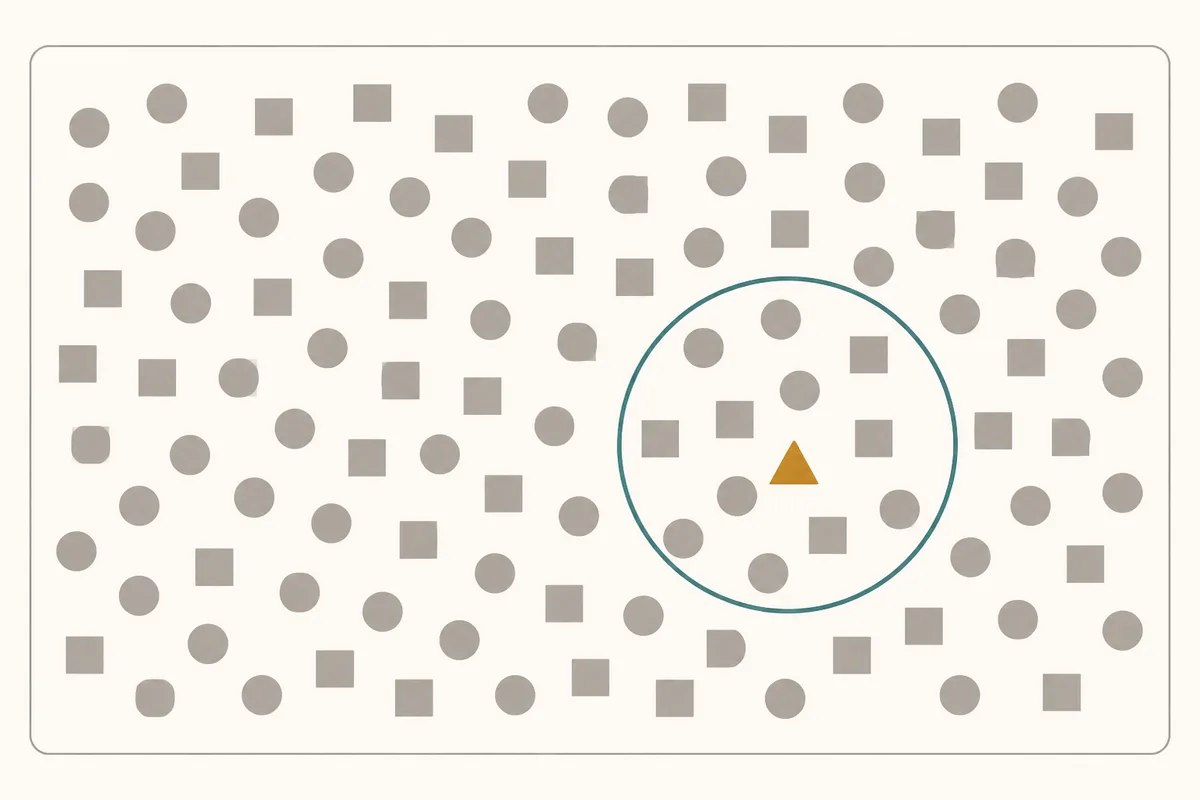
Treisman and Gelade set out why in 1980. A target that differs by one obvious feature, a red dot among green ones, jumps out of a display on its own. A target that shares every feature with its neighbours and differs only in how they are arranged does not jump out at all. You have to walk the display item by item, and every item you skip is a miss you never notice making.
What a data-checking test is used for
Employers call this an attention to detail test, and versions of it turn up in graduate schemes, administration, finance and quality control. The job is almost always the same one. Two records should match. Do they?
Real assessments use invoices, addresses or part numbers. This sheet uses reference codes instead, so no reading speed and no vocabulary come into it. A code carries no meaning to lean on, which strips the task back to the comparison itself.
Nothing here predicts how you would do in a job. It counts how many of eight planted differences you found on one sheet, once. That is the only claim on offer. The part it leans on hardest is holding the original in mind while your eye travels to the copy. How working memory works covers what that costs.
The eight differences, and where four of them hide
Four of the eight are ordinary swaps. One character becomes another that looks nothing like it, so finding those is mostly a matter of looking properly.
The other four are built from the mistakes that survive real checking:
- A look-alike swap. A 5 stands in for an S, an 8 for a B, a 2 for a Z, a 6 for a G.
- A transposed pair. Two neighbouring digits change places, so every character is still there and only the order moved.
No clock, and what that changes
Every other attention test in this hub runs against time. This one does not, and that is the whole point of it. Speed and accuracy trade against each other, so a test that scores both at once measures neither of them cleanly.
Take as long as you want. The result card still shows how long you spent, because it is worth knowing, but nothing in the score depends on it. Somebody who takes four minutes and finds all eight has done better here than somebody who takes forty seconds and finds five.
That is the opposite of the selective attention test, where the entire number is a gap of a few tens of milliseconds. The two results are not comparable and neither one stands in for the other. Your card also reports how many of the four subtle differences you caught. That is the figure separating a careful pass from a quick one.
Reading a count out of eight
Six of eight sits in the middle of the reference distribution. Eight is reachable on a careful pass rather than rare. A count below four usually means the sheet was skimmed rather than checked.
The count only means something if you marked rows you could point at. Marking freely will find differences by accident and tell you nothing about your accuracy. That is why the rows you marked in error sit next to the total.
Practice moves this number quickly. Most of the gain is learning what a planted difference looks like rather than any change in how carefully you read. Treat your first run as the honest one.
Comparing two character strings also loads memory while you do it. What is a good digit span shows how widely that capacity varies. It is part of why two careful checkers come back with different counts.
Questions
What is a good attention to detail test score?
Six of eight is around the middle of the reference distribution. Eight is reachable on a careful pass. A count below four usually means the sheet was skimmed rather than read across.
Can I just mark every row?
You can, and the score stops meaning anything. The card reports how many matching rows you marked in error, so a count padded that way is obvious at a glance.
Is this the test employers use?
It is the same job, not the same instrument. Published assessments use their own material, their own time limits and their own norms, and no score here transfers to one of those.
Why is there no timer?
Because speed and accuracy trade against each other. Scoring both at once measures neither cleanly, and this test is deliberately the accuracy half of that pair.
Which differences do people miss most?
Look-alike swaps and transposed pairs. A 5 standing in for an S keeps the shape of the code intact, and a swapped pair of digits leaves every character present.
Can I take this with a screen reader?
Not usefully. The task is comparing two character strings side by side. Hearing them read out one after the other turns it into a memory test instead.
Does a low count mean I have an attention problem?
No. It means you missed differences on one sheet on one day. Tiredness, screen size and how much you cared all move the count, and none of those is a condition.
Sources
- Treisman AM, Gelade G (1980). A feature-integration theory of attention. Cognitive Psychology, 12(1), 97-136. Link
- Wolfe JM (1998). What can 1 million trials tell us about visual search? Psychological Science, 9(1), 33-39. Link
- Healy AF (1980). Proofreading errors on the word the: New evidence on reading units. Journal of Experimental Psychology: Human Perception and Performance, 6(1), 45-57. Link