Psychomotor Vigilance Task
Watch for a faint signal during three quiet minutes, with every missed response counted as a lapse.
Settings
Changing one restarts the attempt, and scores set under different settings are not comparable.
Quick start
- 1Sit somewhere quiet with notifications off. This test punishes interruption by design.
- 2Click Start. A counter starts running at moments you cannot predict.
- 3Press the space bar as soon as it starts. It stops and shows your time.
- 4Do not press between counters. Early presses are counted as false starts.
- 5After three minutes you get your lapse count, your average, and your fastest tenth.
Loading test
How you compare
Lapses (lapses). Lower is faster. Reference distribution, not CognitiveDrill data.
The median for this test is 3 lapses. Take a run and your score appears on the bar.
Reference distribution, not CognitiveDrill data. It is shaped to match published results for this task and is replaced by our own norms once a cohort reaches n = 1,000. Shape based on: Dinges DF, Powell JW; Basner M, Mollicone D, Dinges DF; Van Dongen HPA, Maislin G, Mullington JM, Dinges DF.
Try next
About this test
The reason this task is deliberately boring
Dinges and Powell built this task in 1985 for sleep research. It has two properties almost no other cognitive test has. Practice barely helps, so repeating it does not inflate your score. And being clever barely helps either.
What is left is a test that responds almost entirely to how you are right now. That is why sleep researchers made it their standard tool.
Van Dongen and colleagues ran the best-known study. They cut people's sleep for two weeks. Lapses climbed the whole way through. The volunteers' own ratings of how sleepy they felt levelled off early. People stop noticing the damage long before it stops piling up.
What counts as a lapse, and why the line sits at 355 ms
The classic ten-minute version counts any response slower than 500 ms as a lapse. This is the three-minute version, tested by Basner and colleagues in 2011.
It changes two things to make up for the shorter run. Signals arrive 1 to 4 seconds apart rather than 2 to 10. And a lapse now means anything slower than 355 ms.
Those two sets of numbers cannot be swapped. A lapse count from a three-minute run at 355 ms is not the same thing as one from a ten-minute run at 500 ms. Mixing them up is a common way to be wrong about your own data. This tool labels which version you ran, and the reference distribution covers the three-minute one only.
Why the counter is visible while it runs
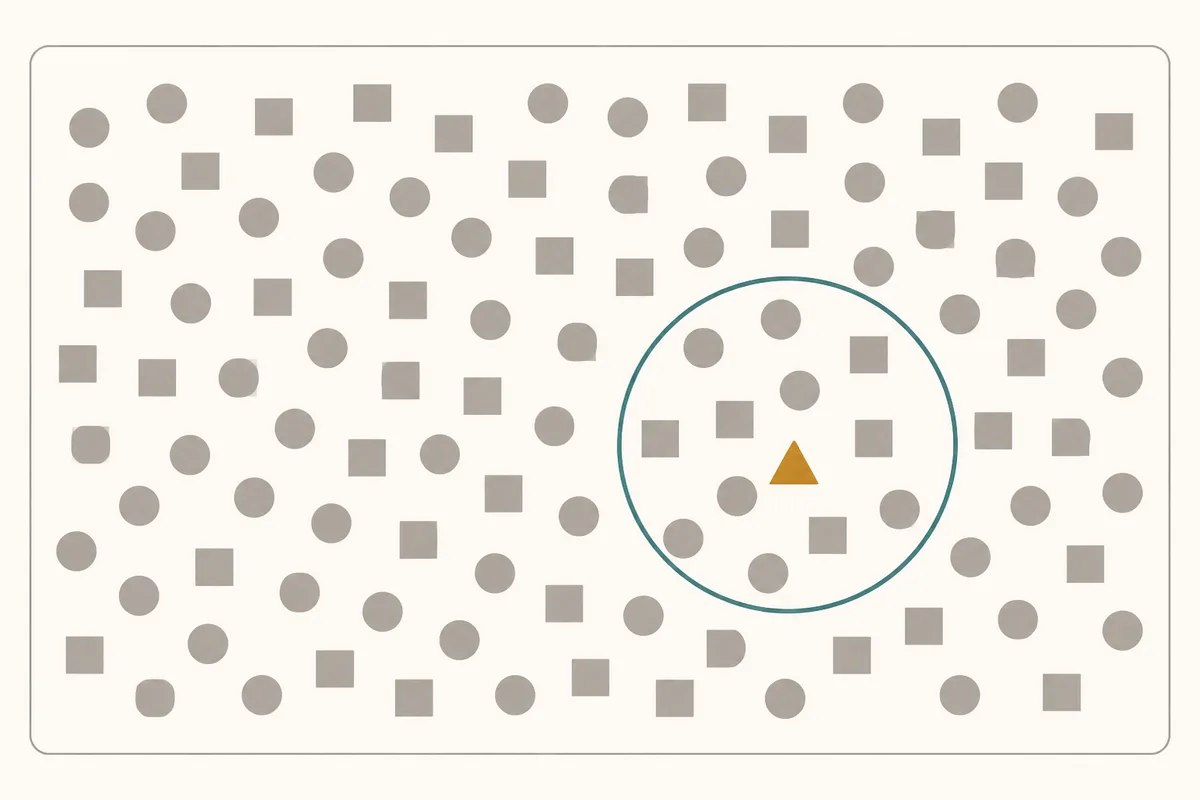
In the original machine the thing you react to is a counter. It starts running and stops when you press, so you watch your own time pile up.
Most web versions drop that detail. Dropping it removes the feedback that keeps people going through a deliberately dull three minutes.
It also makes false starts obvious. Pressing before the counter appears is scored on its own rather than folded into your times. More than a handful of false starts ruins a run. It usually means you were guessing the gap rather than reacting. Beating that guess is exactly what the random gap is for.
Using it on yourself
This is the one test on the site genuinely worth repeating. Run it at the same time of day, on the same hardware, for a week.
Lapse counts that climb over a fortnight are the clearest signal about your own sleep debt a browser can give you. Unlike almost everything else here, practice does not muddy the number.
This browser version records lapses under the conditions of your run. It cannot tell you whether you are safe to drive.
For how much any reaction-based measure varies between people, see average reaction time by age and what counts as a good reaction time.
Questions
How many lapses are normal?
On a rested three-minute run, most people record between zero and three. Counts rising past five or six typically indicate sleep debt, illness or a genuinely noisy environment.
Why is the lapse threshold 355 ms here and 500 ms elsewhere?
Because this is the three-minute PVT-B, which uses a shorter interval range and a lower lapse threshold. Numbers from a ten-minute PVT are not comparable.
Can this tell me if I am too tired to drive?
No. It is a research instrument, not a fitness-for-duty test, and a browser cannot control the conditions that make such a judgement valid.
Why does the task feel so long?
Because it is meant to. The boredom is the mechanism. Lapses only appear when a task is too dull to hold your attention, so making the waits shorter would remove the very thing being measured.
Does practice improve PVT scores?
Barely, which is what makes it useful. Practice effects are minimal after the first run, so changes over days generally reflect your state rather than your familiarity.
Sources
- Dinges DF, Powell JW (1985). Microcomputer analyses of performance on a portable, simple visual RT task during sustained operations. Behavior Research Methods, Instruments, & Computers, 17(6), 652-655. Link
- Basner M, Mollicone D, Dinges DF (2011). Validity and sensitivity of a brief psychomotor vigilance test (PVT-B) to total and partial sleep deprivation. Acta Astronautica, 69(11-12), 949-959. Link
- Van Dongen HPA, Maislin G, Mullington JM, Dinges DF (2003). The cumulative cost of additional wakefulness. Sleep, 26(2), 117-126. Link