Verbal Memory Test
Read words one at a time and decide whether each has appeared before, with false alarms subtracted from your hits.
Settings
Changing one restarts the attempt, and scores set under different settings are not comparable.
Quick start
- 1Press Play. One word appears in the middle of the canvas.
- 2Decide whether that word has already been past in this run.
- 3Answer Seen or New. The S and N keys do the same job.
- 4Keep going. Sixty-four words arrive and thirty of them are repeats.
- 5Nothing tells you whether you were right. The number comes at the end.
Loading test
How you compare
Net words recognised (words). Higher is better. Reference distribution, not CognitiveDrill data.
The median for this test is 22 words. Take a run and your score appears on the bar.
Reference distribution, not CognitiveDrill data. It is shaped to match published results for this task and is replaced by our own norms once a cohort reaches n = 1,000. Shape based on: Hockley WE; Shepard RN, Teghtsoonian M; Snodgrass JG, Corwin J.
Try next
About this test
One list that is also the test
Most memory tests come in two halves. You study something, it is taken away, and then you are asked about it. This one has no halves. Words arrive one at a time, and every word is two jobs at once. It is something to judge now and something to hold for later.
Shepard and Teghtsoonian built the task this way in 1961, for a practical reason. A study list has an end, so the last few items are still ringing when the questions start. A list that keeps going never gives you that. By the twentieth word you are carrying a bag of half-seen things. That is a good deal closer to how memory gets used away from a desk.
Sixty-four words go past here. Thirty are ones you have already been shown. Four appear once and never come back, and those are not padding. Without them the closing trials would be answerable by arithmetic rather than by memory. Once every word has been introduced, there is nothing left for a slot to hold but a repeat.
The trap in counting only your hits
There is an easy way to catch every repeat. Answer Seen to all sixty-four words. You would miss nothing at all, and you would have shown nothing at all.
So the score subtracts. It takes the repeats you caught and removes the new words you wrongly called repeats. Snodgrass and Corwin set this correction out in 1988 and it is the ordinary way to read a recognition test. Answer Seen to everything and the result lands below zero. Answer New to everything and it lands exactly on zero. The only route to a high number is telling the two apart.
Both halves sit on the result card. Repeats caught is your hits out of thirty. False alarms is how often a word you had never seen felt familiar anyway. Two people can arrive at one score from very different places, and that pair of figures is where you see which.
How far back the repeat was
A word repeated two words later is almost free. The same word repeated thirty words later is not. Hockley measured that curve in 1982 on this exact task. The further back the first sighting, the more often people missed it and the longer they took to answer.
The stream mixes those distances deliberately. Some repeats come straight back and some are buried thirty words deep. The score then averages easy trials with hard ones instead of reading one distance.
Repeat distance is a setting and it does one thing. Close repeats only puts every second sighting within nine words of the first. That is a much easier run and the score goes up accordingly. The comparison on this page was drawn for the mixed setting. Treat a close-only score as its own reading rather than something to put on the bar.
There is no distant-only option, and the reason is arithmetic rather than taste. Push every repeat past ten words and the opening eleven trials could not be repeats even in principle. A stretch of free marks is not a harder test.
Common words, rare words, and which is easier
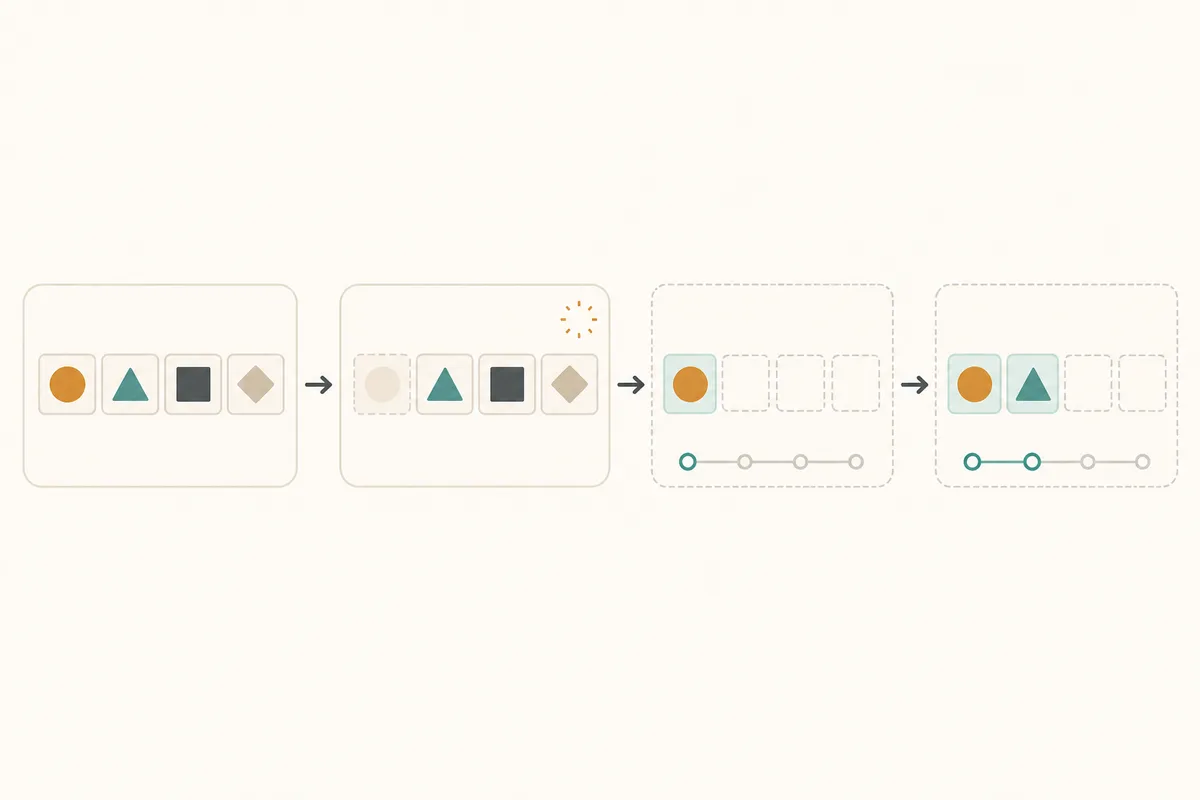
The other setting swaps the pool. Everyday words such as harbour and pencil, or less common ones such as gargoyle and thimble.
Most people expect the rare words to be harder. They are not. Glanzer and Adams described the pattern in 1985 and called it the mirror effect. Rare words are caught more often as repeats, and they draw fewer false alarms too. Both halves of the score move the right way at once.
The usual explanation is that a rare word turns up carrying less history. You have met pencil in thousands of places, so a feeling of familiarity tells you nothing about this particular list. Gargoyle has almost no competition, so that same feeling means something. The pool is a setting rather than a fixed choice because watching your own two numbers move is a better demonstration than a paragraph.
What this number does not reach
Recognition is the easy half of memory. Being handed a word and asked whether you have seen it is one thing. Being handed a blank page and asked what was on the list is quite another. Shepard found in 1967 that people recognise around nine in ten words they have just read. Free recall of the same list is far worse.
A high score here says your recognition is in good order. It does not say you would remember a shopping list, a name at a party, or where you put your keys. Those are recall, and this page does not test it.
It does not test digits either. The digit span test hands you a list and asks for it back in order, so it needs the order as well as the items. This asks only whether a thing is familiar. How working memory works covers why saying things under your breath helps one of those far more than the other. The figures for the span test are in what counts as a good digit span.
One run is one run. Scores climb over the first few attempts purely from learning what the buttons do. If you want to know whether anything real has shifted, compare weeks rather than minutes. Read whether brain training games are worth it before taking a rising number for a better memory.
Questions
What is a good score on this test?
The middle of the modelled distribution sits around 22 out of a possible 30. Above 27 is strong. The figure on the card is already net of your false alarms.
Why is my score lower than the number of repeats I caught?
Because every new word you called a repeat comes off the total. The card shows both figures side by side, so you can see which half cost you the points.
Does answering faster help?
No. Nothing here is scored on speed. The median decision time on the card is there because it is interesting, not because it earns anything.
Are the words the same every time?
No. Each run draws a fresh set from a pool of more than ninety. The distances between a word and its repeat are drawn again too.
Why am I not told whether each answer was right?
Being told would let you track how often Seen has been the answer and lean that way. That shifts your false alarm count, which is half of the score.
Is a low score a sign of a memory problem?
On its own, no. Recognition drops with tiredness, noise and a busy room. The useful comparison is another run under the same setup.
Can I train this?
Your score will rise over the first few runs as you learn the format. That is practice at this task. It is not evidence that your memory has changed.
Sources
- Shepard RN, Teghtsoonian M (1961). Retention of information under conditions approaching a steady state. Journal of Experimental Psychology, 62(3), 302-309. Link
- Hockley WE (1982). Retrieval processes in continuous recognition. Journal of Experimental Psychology: Learning, Memory, and Cognition, 8(6), 497-512. Link
- Snodgrass JG, Corwin J (1988). Pragmatics of measuring recognition memory: applications to dementia and amnesia. Journal of Experimental Psychology: General, 117(1), 34-50. Link
- Glanzer M, Adams JK (1985). The mirror effect in recognition memory. Memory & Cognition, 13(1), 8-20. Link
- Shepard RN (1967). Recognition memory for words, sentences, and pictures. Journal of Verbal Learning and Verbal Behavior, 6(1), 156-163. Link