Photographic Memory Test
Study a picture for five seconds, then answer three questions about the details it contained.
Settings
Changing one restarts the attempt, and scores set under different settings are not comparable.
Quick start
- 1Click Start. A picture appears and stays for five seconds.
- 2Look at the whole thing. Count what you see and note where it sits.
- 3The picture goes. Three questions follow about what was in it.
- 4Answer each one. Nothing is timed here, so take the time you need.
- 5Another picture follows. Your score is the share of questions you got right.
Loading test
Why there is no comparison
Picture recall accuracy (%). Higher is better. No published distribution exists for this task.
Every other test here draws your score on a bar of published results. This one cannot. Nobody has measured enough people on this task to say what a typical result is, so a bar here would be a picture of a number we made up.
Numbers for this task do circulate. The ones we could find name no study and do not agree with each other. We would rather show you nothing than repeat one of those.
No published distribution, and not CognitiveDrill data either. Nobody has measured this task on a large enough sample to say what a typical result is, so this page shows your number and does not rank it. Our own norm is published once a cohort reaches n = 1,000.
Try next
About this test
What five seconds of a picture leaves behind
You will finish the five seconds sure you saw the whole picture. In a sense you did. The problem arrives with the first question, which asks for something you looked straight at and did not store.
George Sperling showed why in 1960. He flashed a grid of letters and asked for one row a moment later. People could produce whichever row he named, so almost all of it was briefly available. Wait, and most of it was gone. Seeing is not keeping, and the gap between them is what this test measures.
Five seconds is far longer than Sperling allowed, and that is deliberate. It is long enough to choose what to encode. So the score reflects how well you spend a look, not how fast your eyes are.
How the questions are built, and why it matters
Every picture is drawn from a written specification: what is in it, how many of each, what colour, and where it sits. The questions are generated from that same specification.
That is not a shortcut, it is the only honest way to score a picture test. A question written by hand about a picture is a claim that somebody looked carefully and got it right. Build the question from the specification the picture came from and it can only be wrong if the picture is wrong. That is a thing which can be checked once and for all.
Questions with two right answers are refused rather than guessed at. If a scene holds two things that would both answer a question, that question is not asked about that scene.
Photographic memory, and why the phrase misleads
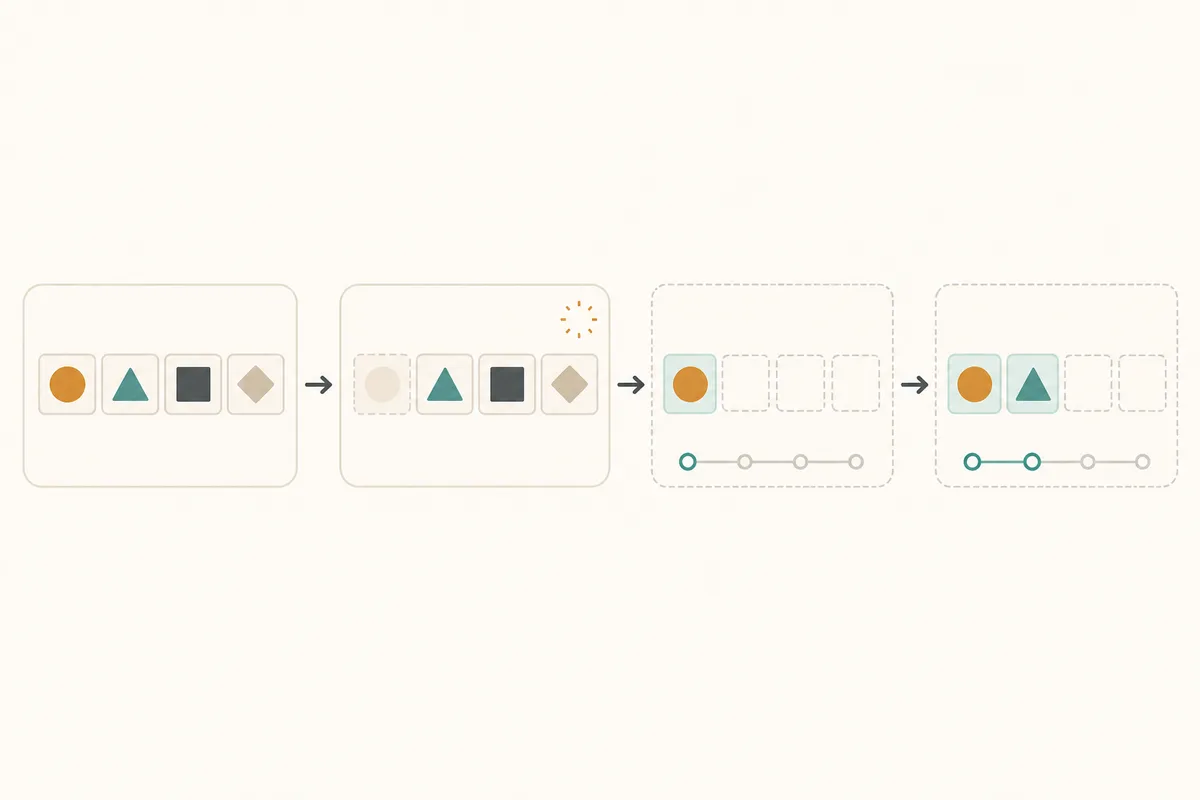
Photographic memory, in the everyday sense, means glancing at a page and reading it back in full later. Under a controlled test, no healthy adult has ever shown it. The nearest real thing is eidetic imagery, it turns up in a small number of young children, and it is patchy and brief.
What people call a photographic memory is usually a trained trick. Chess masters recall a board at a glance, but only a real position, never a random one. They are reading meaning, not pixels.
This test leans the other way on purpose. The scenes hold plain shapes in plain colours, so there is no story to compress them into. What is left is how much of a look you actually keep.
Reading your own number
The score is the share of questions you answered correctly, so guessing has a floor. Four answers a question means a run of pure guesses lands near 25 per cent. Anything at or below that is not a measurement of memory.
There is no published distribution for this task, and the page says so rather than ranking you against a number we made up. What it is good for is your own history: the same task, the same five seconds, run again next week.
A low score is not a memory problem. For why holding and juggling are different jobs, read how working memory works. To lean on words instead of a picture, try the digit span test. For the spatial version of the same question, see what counts as a good digit span.
Questions
How long is each picture on screen?
Five seconds, and the clock starts when the picture has finished loading rather than when the round begins. On a slow connection those are not the same moment, and starting at the wrong one would hand you a shorter look.
Does a high score mean I have a photographic memory?
No. It means you spend a five second look well, which is a real skill. True photographic memory, recalling a scene in full detail at will, has never held up under a controlled test.
Are the questions the same every time?
No. Each picture supports more questions than the three you get, and which three are asked is drawn fresh each time. Meeting the same picture twice is not the same round twice.
Is a low score a sign of a memory problem?
No. The task is meant to overload everyone, so a low number is normal. Tiredness, a small screen and an unfamiliar layout all pull it down. Repeat it under the same conditions to compare runs.
Why is there no percentile for my score?
Because nobody has published a distribution for this task, and we will not invent one. Once enough real results have been collected here, the page will place you against those and say so.
Can I train myself to do better?
A bit. Deciding what to look at before the five seconds run out helps more than staring harder. That gain is specific to this task though, and it will not improve your memory in daily life.