Aphantasia Test
Picture four everyday scenes and rate how vivid each felt. A self-report placed in a range, with no better end.
Quick start
- 1Click Start. A short prompt names a scene and one thing in it to picture.
- 2Close your eyes for a moment if it helps, and bring the picture to mind.
- 3Rate how vivid it felt, from 1 for no image to 5 for as vivid as real sight.
- 4The next prompt appears. There are sixteen in all, across four scenes.
- 5Answer with your first impression. There are no right or wrong answers here.
Loading test
Where this sits
VVIQ vividness score (points). This scale has no better or worse end. Reference distribution, not CognitiveDrill data.
The middle of the reference distribution is 62 points. Take the questionnaire and your score appears on the bar.
Reference distribution, not CognitiveDrill data. It is shaped to match published VVIQ score ranges and is replaced by our own norms once a cohort reaches n = 1,000. Very low scores (around 32 or below) are described as aphantasia and very high scores as hyperphantasia, both a normal part of the range. Shape based on: Marks DF; Zeman A, Milton F, Della Sala S, et al..
Try next
About this test
What this questionnaire asks
Close your eyes and picture a sunrise. Some people see it in full colour, as clear as a photograph. Others get a faint suggestion, and some get nothing at all. This questionnaire asks where you fall on that range.
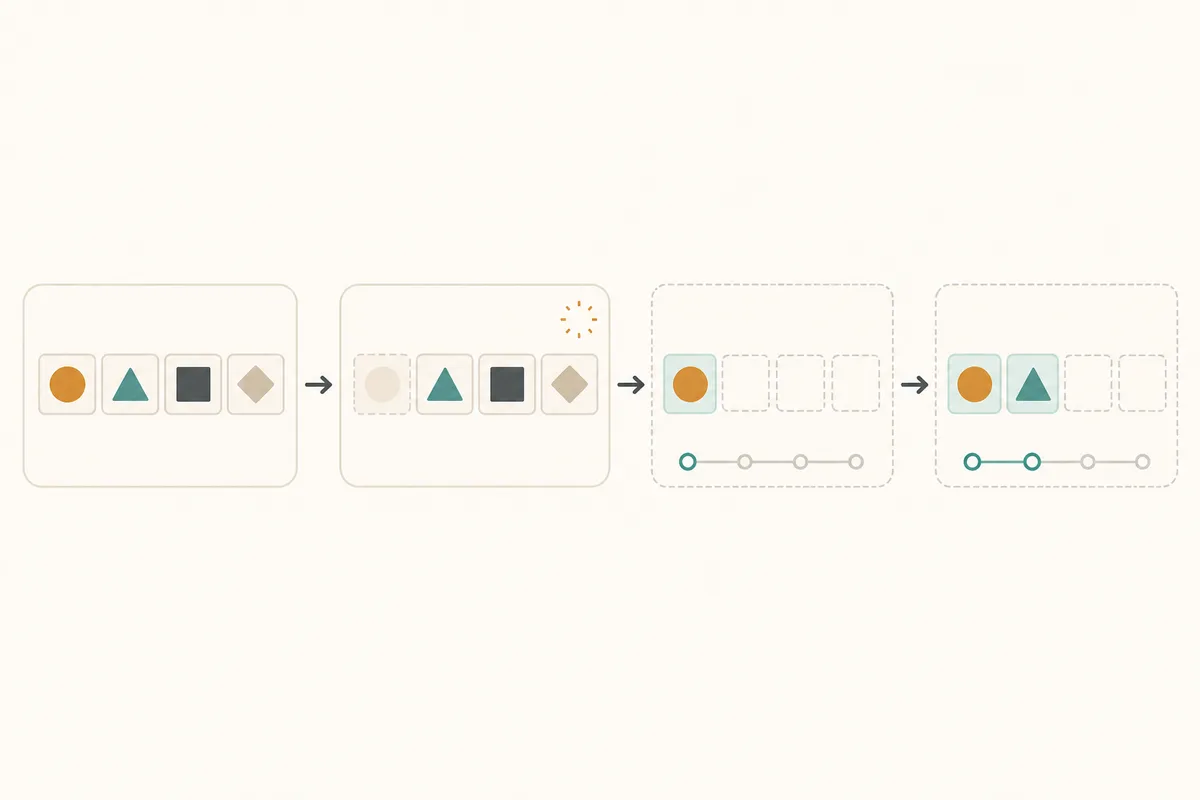
It measures the vividness of your visual imagery by self-report. There is no picture on the screen to remember and nothing to react to. You bring each scene to mind yourself and rate how clear it was.
So this is not a test of skill, and it cannot be passed or failed. It records how something felt to you, which is a thing only you can report.
Where the questionnaire comes from
David Marks published the Vividness of Visual Imagery Questionnaire in 1973. It asks you to picture four familiar scenes, with four details in each, and to rate the clarity of every one.
Our version keeps that structure and writes the prompts afresh. The four scenes are a person you know, a sunrise, a shop you visit and a stretch of open country.
The scale runs from 1 to 5. Here 1 means no image at all, and 5 means a picture as vivid as really seeing it. Add up the sixteen ratings and the total lands between 16 and 80.
Aphantasia and hyperphantasia, both ordinary
Adam Zeman named aphantasia in 2015, for people who picture little or nothing when they try. At the other end of the range he put hyperphantasia, imagery as vivid as real sight.
Both are a normal variation, not a deficit. Plenty of people who report no mental pictures work as artists, designers and engineers, and had no idea they differed from anyone else.
On this scale a total around 32 or below is usually described as aphantasia. A total near the top is described as hyperphantasia. Neither end is better than the middle.
How to read your placement
Your score is placed in the reference distribution with no better or worse end. It shows where a total of that size sits, and nothing about how good your memory or your mind is.
That distribution is a reference model built from the published literature, not our own data. It says roughly how common a score like yours is, so a low or a high total is put in proportion.
Vividness and memory are largely separate. For how short-term memory actually works, read how working memory works. To try a memory task with a real span, take the visual memory test. For the percentile side, what counts as a good digit span explains how those numbers are read.
What this is not
This questionnaire records how vivid your mental pictures felt today.
It is not a test of intelligence or memory power either. How vivid your imagery feels does not set how much you can remember or how well you think.
Imagery varies widely from person to person. The result describes how vivid the prompted scenes felt during this questionnaire.
Questions
What is a good score on the aphantasia test?
There is no good or bad score, because the scale has no better end. A total near 62 sits in the middle of the range, and both lower and higher totals are common and normal.
What score counts as aphantasia?
On this scale a total of around 32 or below is usually described as aphantasia. It means you picture little or nothing, which is a normal variation rather than a fault.
Is aphantasia a disorder?
No. It is a normal variation in how minds work, and most people who have it manage everyday life with no difficulty. This result only summarises your answers to the prompts.
Does a low score mean I have a bad memory?
No. The vividness of your imagery and the amount you can remember are largely separate. People with little imagery often have ordinary or excellent memories.
Can I train my imagery to be more vivid?
Some people report changes with practice, and the evidence is thin either way. This questionnaire is a snapshot of how things feel now, not a training tool.
Is this the same as the clinical VVIQ?
It is based on the VVIQ and keeps its structure, with our own wording for the prompts. The comparison is a reference model rather than observed CognitiveDrill results.
Sources
- Marks DF (1973). Visual imagery differences in the recall of pictures. British Journal of Psychology, 64(1), 17-24. Link
- Zeman A, Dewar M, Della Sala S (2015). Lives without imagery: congenital aphantasia. Cortex, 73, 378-380. Link
- Zeman A, Milton F, Della Sala S, et al. (2020). Phantasia: the psychological significance of lifelong visual imagery vividness extremes. Cortex, 130, 426-440. Link