Digit Span Test
Watch digits appear one at a time, then type them back as the list grows longer with each round.
Settings
Changing one restarts the attempt, and scores set under different settings are not comparable.
Quick start
- 1Click Start. A three-digit list appears, one digit at a time.
- 2When it finishes, type the digits back in order and press Enter.
- 3Get it right and the next list is one digit longer.
- 4Get it wrong and you get one more go at that length. Miss twice and the run ends.
- 5Your span is the longest list you got right.
Loading test
How you compare
Forward digit span (digits). Higher is better. Reference distribution, not CognitiveDrill data.
The median for this test is 7 digits. Take a run and your score appears on the bar.
Reference distribution, not CognitiveDrill data. It is shaped to match published results for this task and is replaced by our own norms once a cohort reaches n = 1,000. Shape based on: Miller GA; Wechsler D; Cowan N.
Try next
About this test
The oldest test on this site
Joseph Jacobs measured digit span in schoolchildren in 1887, and it has been in use ever since. It sits inside every major clinical intelligence test, including the Wechsler scales. That is the reason to take it rather than something more inventive. Nothing else on this site has as much published comparison data behind it.
The forward version is a fairly clean measure of how much you can hold in words. The backward version, in settings, makes you hold the list and turn it around. That is extra work. It is why clinicians treat forward and backward spans as two different measurements rather than two versions of one.
Seven, plus or minus a misunderstanding
Everybody knows the magical number seven. Almost nobody has read the paper. Miller's 1956 argument was about chunks, not digits. A chunk is whatever your memory treats as a single unit. 'M I 5' is three letters or one thing, depending on who you are. Cowan revisited this in 2001 using methods that stop you rehearsing or grouping. His figure for raw capacity is closer to four.
That matters for reading your own score. A span of nine almost never means nine separate slots. It usually means you grouped the digits into pairs and triples without noticing. That is a technique, and techniques can be trained. Raw capacity cannot, or not nearly as easily. The details are in what counts as a good digit span.
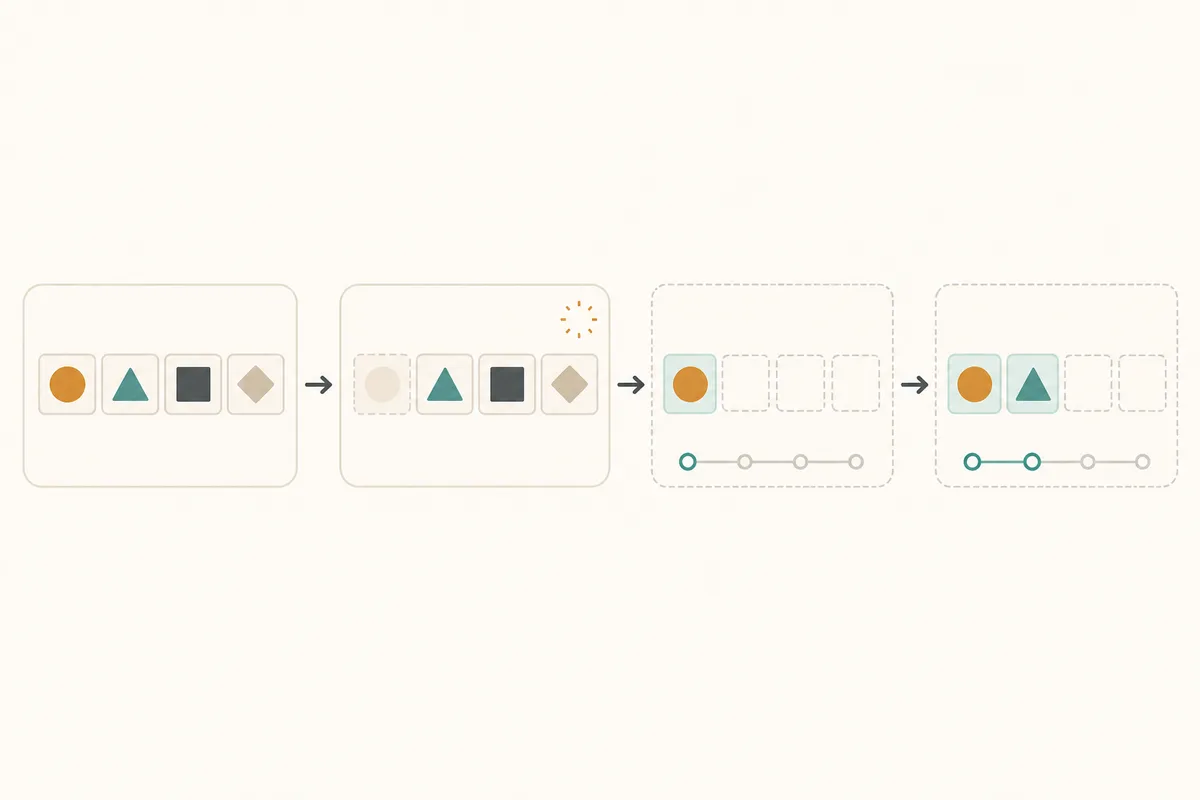
How this version is scored
You get two attempts at each length. Fail both at the same length and the run ends. Your span is the longest length you got right. That rule is common and it keeps runs short.
It is not the Wechsler rule. Clinical digit span scores every trial across a fixed set of lengths and produces a scaled score, not a single span figure. So a number from this page cannot be swapped for a clinical result.
No list ever repeats a digit twice in a row, and every attempt gets a fresh sequence. Digits arrive one per second by default. Speed matters here: your span drops when they come faster and rises when they come slower. That is why the rate is a setting you can see rather than something hidden.
Getting an honest span
Do not write anything down. Do not gabble the list under your breath to squeeze more into your head. And do not take the test five times in a row and expect the number to mean much. Span climbs by a point or so over the first few attempts purely from getting used to the interface.
How working memory works explains why saying things to yourself makes this task easier than its spatial twin. To see your span without that crutch, take the Corsi block-tapping test. It uses positions on a board, which you cannot say to yourself. Most people score one to two units lower, and the size of that gap is more interesting than either number alone.
Questions
What is a normal digit span?
Seven digits forward is the classic middle of the distribution for adults, with most people between five and nine. Backward spans typically run one to two digits shorter.
Is a low digit span a sign of a memory problem?
On its own, no. Span is affected by attention, tiredness, noise, and how familiar you are with the format. A clinical judgement needs a full assessment, not a browser test.
Can I train my digit span?
You can raise your score substantially by learning to chunk, and one famous case study reached over 80 digits using an elaborate encoding strategy. The strategy does not carry over to other kinds of material.
Why does the test stop so suddenly?
Two failures at the same length is the stopping rule. It keeps runs to a couple of minutes and puts the estimate close to the point where you genuinely stop coping.
Does the backward version measure something different?
Yes. Reversing a list requires holding it and manipulating it at the same time, which involves working memory rather than storage alone. Clinicians score the two separately for that reason.
Sources
- Miller GA (1956). The magical number seven, plus or minus two: some limits on our capacity for processing information. Psychological Review, 63(2), 81-97. Link
- Cowan N (2001). The magical number 4 in short-term memory: a reconsideration of mental storage capacity. Behavioral and Brain Sciences, 24(1), 87-114. Link
- Wechsler D (2008). Wechsler Adult Intelligence Scale, Fourth Edition (WAIS-IV): Technical and Interpretive Manual. Pearson. Link