Number Comparison Test
Compare number pairs from three to nine digits long, then see how many you answered correctly in one minute.
Settings
Changing one restarts the attempt, and scores set under different settings are not comparable.
Quick start
- 1Read the number on top.
- 2Read the number underneath it.
- 3Press Same if every digit matches.
- 4Press Different if one digit does not.
- 5Keep going. The next pair arrives the moment you answer.
Loading test
Why there is no comparison
Correct pairs per minute (pairs/min). Higher is better. No published distribution exists for this task.
Every other test here draws your score on a bar of published results. This one cannot. Nobody has measured enough people on this task to say what a typical result is, so a bar here would be a picture of a number we made up.
Numbers for this task do circulate. The ones we could find name no study and do not agree with each other. We would rather show you nothing than repeat one of those.
No published distribution, and not CognitiveDrill data either. Nobody has measured this task on a large enough sample to say what a typical result is, so this page shows your number and does not rank it. Our own norm is published once a cohort reaches n = 1,000.
Try next
About this test
Three digits to nine, and the length is doing the work
Every pair asks one question. Two numbers sit one above the other. Are they the same?
The numbers are not all the same size. A run cycles through every length from three digits to nine, in an order you cannot read. Each length turns up the same number of times, so no run is easier than another by luck.
Length is what turns this from a glance into a measurement. Three digits arrive in one look. Nine do not, so the eye works along the two rows and has to keep hold of the part it has already cleared. That holding is where the seconds go, and how working memory works is the clearest account of it on this site.
The digit that differs sits anywhere in the number, chosen fresh for every pair. Put it near the end and every mismatch would cost a full read. Put it near the front and the long numbers would stop being long.
The two numbers are stacked rather than set side by side, and the digits line up in columns. That is how anyone compares two long numbers on paper. Placing them apart would add a journey across the screen to a task that is meant to measure a comparison.
A wrong pair still costs the seconds it took
The headline is correct pairs per minute. The top of that fraction counts the pairs you got right. The bottom counts all the time you spent, including the time spent on the ones you got wrong.
That is the published way of scoring this family of tasks, and it is there to stop one strategy. A rate that charged nothing for an error would reward guessing. Press a button at random twice a second and half your answers come out right. A clock that never billed you for the other half would call that a good run.
Charge the time and guessing stops paying. A wrong answer adds to the seconds and nothing to the count, so the quickest honest route through the run is to read properly.
Accuracy sits next to the rate all the same. A run at 96% and a run at 78% can land on the same figure, and they are not the same run.
It is also why the length of the run is yours to choose. A rate is already divided by its own clock, so fourteen pairs and forty two pairs produce a number that means the same thing. The longer runs are steadier, in the way any measurement taken more times is steadier.
Nobody has published a rate for a version with buttons
The comparison block on this page draws no bar. No percentile, no band, no better than most. The reason is more interesting than a missing dataset.
This task was never built to score a person. It was built to measure the gap between groups of different ages, on a printed sheet, with a pen. What the studies report is how far one group sits from another. None of them set out to say what a good rate is, so there is no published cut-off to borrow.
The pen matters more than it sounds. Writing an S or a D takes a large share of the time each row costs. Pressing a button takes a much smaller one. A rate collected with a pen is therefore a rate for an activity this page does not ask you to do.
So this page shows your rate, your best and your own history, and says the ranking does not exist. The part of the published work that does survive the move to a screen is the shape of the age effect. Processing speed by age sets that out as percentages rather than raw rates, which is the only form that travels.
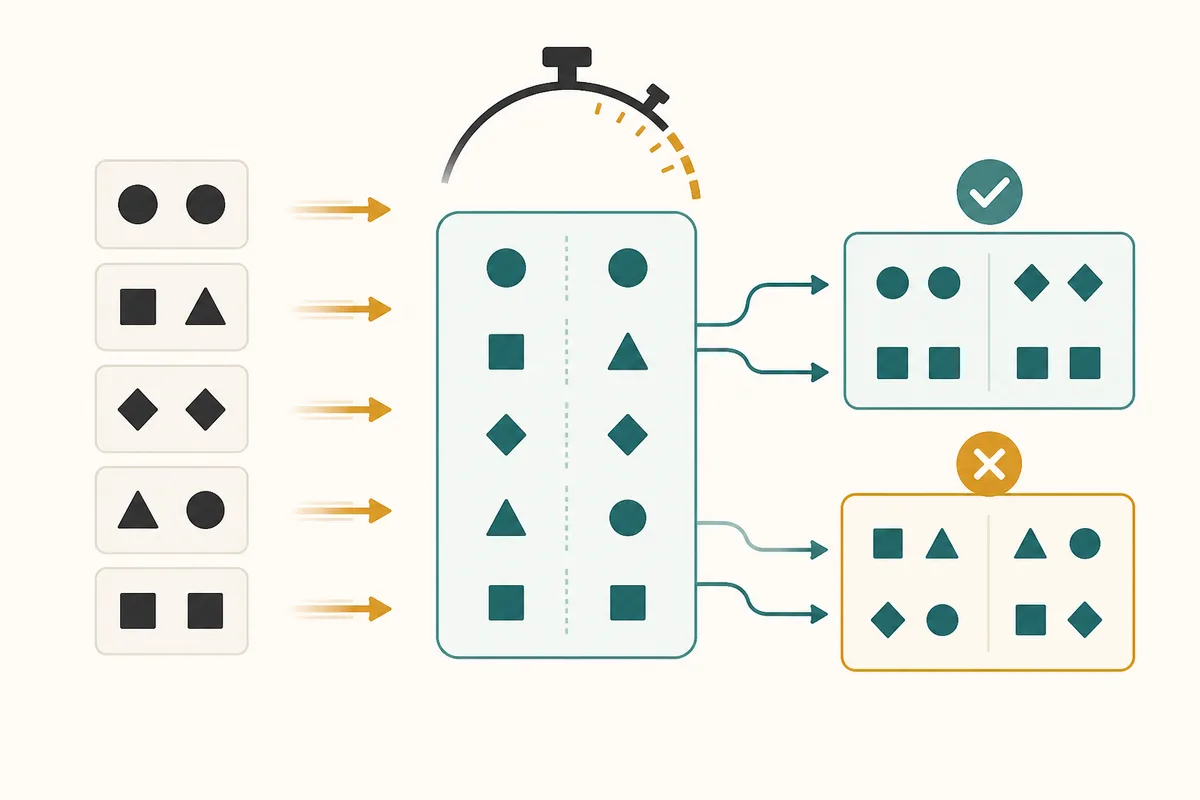
The mistake worth knowing about is stopping early
The card counts one kind of error on its own: mismatched pairs you called the same.
That error has a single cause. You answered before you reached the digit that differed. It is the one mistake this task is really about, because the whole job is to keep reading until you are sure.
The opposite error, calling a matching pair different, comes from misreading a digit rather than from missing one. It is rarer and it is not counted separately.
The rate on the long pairs sits beside it on the card, and the two are read together. Long pairs are where a reader who is racing runs out of patience first.
- Several mismatches called the same, on a high rate, means you are guessing once the numbers get long.
- None of them, on a low rate, usually means you are checking every digit twice when once would do.
- A long-pair rate close to your overall rate is unusual, and it normally means the short pairs are being read slowly.
What a high rate here is and is not
A high rate says you compared strings of digits quickly and accurately, on this screen, today. That is the whole of it.
It is not an intelligence score and it is not a measure of how quickly you think in general. The figure describes performance on this digit-comparison task only.
Practice will move the number, and what improves is this task. Getting quicker at comparing numbers makes you quicker at comparing numbers.
Your eyes and your screen are in the figure too. Small digits on a dim laptop cost you time that has nothing to do with thinking. Repeat it under the same conditions to compare runs.
Questions
What is a good rate on this test?
There is no published figure for a version answered with buttons, so there is no honest cut-off to quote. We would rather show you nothing than repeat a number nobody measured. Your own best over several runs is the comparison worth having.
Why does the page not give me a percentile?
A percentile needs a distribution, and the published ones count rows marked with a pen on a printed sheet. Writing a letter is a large share of the time each row takes there, and pressing a button is not. Converting one into the other would be a guess with a bar drawn around it.
Do the numbers get longer as the run goes on?
No. Every length from three digits to nine turns up the same number of times, shuffled into an order you cannot read. A run never ramps up, so a slow patch is about you rather than about the pairs you were handed.
Do wrong answers lower my score?
Twice over. A wrong pair earns no credit, and the seconds it took still count against the minute. That is deliberate, because a rate that ignored the cost of an error would pay you for guessing.
Can I take it with the keyboard?
Yes. S answers same and D answers different, and the left and right arrows do the same job. The arrows are the quicker pair, because both hands can rest and neither answer needs a longer reach than the other.
Why did some of my presses do nothing?
A press that lands within 100 ms of a new pair cannot be an answer to it. Nobody reads two numbers that quickly. Those are treated as a press that bounced, dropped from the timing, and counted on the result card.
Does the length of the run change my rate?
Not what it means. A rate is already per minute, so a short run and a long one are comparable. A longer run gives a steadier figure, in the same way any measurement taken more times is steadier.
How is this different from the symbol search test?
There you sweep a row of shapes for either of two targets, and the number is how long one decision took. Here you read two numbers against each other, and the number is how many pairs a minute you clear. Digits also have an order and a name, which shapes do not.
Sources
- Salthouse TA, Babcock RL (1991). Decomposing adult age differences in working memory. Developmental Psychology, 27(5), 763-776. Link
- Salthouse TA (1996). The processing-speed theory of adult age differences in cognition. Psychological Review, 103(3), 403-428. Link
- Verhaeghen P, Salthouse TA (1997). Meta-analyses of age-cognition relations in adulthood. Psychological Bulletin, 122(3), 231-249. Link