Digit Symbol Substitution Test
Match nine digits to nine symbols for ninety seconds, with your score showing how many answers you completed correctly.
Quick start
- 1Read the key along the top. Every digit from 1 to 9 has one symbol.
- 2Press start. A large digit appears with the next four behind it.
- 3Find that digit in the key. Press the matching symbol on the pad.
- 4Keep going. The next digit arrives the moment you answer.
- 5Stop when the clock reaches zero at ninety seconds.
Loading test
Why there is no comparison
Correct substitutions in 90 seconds (items). Higher is better. No published distribution exists for this task.
Every other test here draws your score on a bar of published results. This one cannot. Nobody has measured enough people on this task to say what a typical result is, so a bar here would be a picture of a number we made up.
Numbers for this task do circulate. The ones we could find name no study and do not agree with each other. We would rather show you nothing than repeat one of those.
No published distribution, and not CognitiveDrill data either. Nobody has measured this task on a large enough sample to say what a typical result is, so this page shows your number and does not rank it. Our own norm is published once a cohort reaches n = 1,000.
Try next
About this test
Ninety seconds, and the clock is not yours to set
Every other test on this site offers you a length. This one does not, and the reason is that the score is a count rather than a rate.
A count only means something next to the clock it was taken against. Sixty substitutions is a good run in ninety seconds and a poor one in three minutes. Offer the choice and the same number on the same card would describe two different performances. Your own history would stop being a history, because run four would no longer be comparable with run one.
The published versions of this task fix the clock for the same reason. Ninety seconds is the window the classic pencil form uses, so that is the window here. It is long enough that the first few slow items stop dominating the total, and short enough that nobody is measuring your patience.
The clock also keeps running through a wrong answer. There is no penalty and no correction. You pick a symbol, the next digit arrives, and the run carries on. Accuracy is reported separately on the card. A fast and careless run and a slower exact one can finish on the same count.
The key stays on screen, so nothing is being remembered
The row of nine pairings at the top never disappears. That is not a kindness, it is the design of the task. Hide the key and the score becomes a measure of how much you memorised, which is a different test with a different number.
What is left when memory is taken out is a small loop that runs once per item. You read a digit. Your eye travels to the key and finds that digit. You read the symbol under it, hold that shape for the moment it takes to look away, and find the same shape on the pad. Then you press.
Each of those steps is quick. The count is high because the loop is short, and it is a useful number because almost nothing else is going on. There is no puzzle, no vocabulary and no trick. Whatever slows the loop down shows up directly in the total.
The pad is laid out in the symbols' own order and the key is not. If the two matched, the answer to every item would be the position of the digit rather than its symbol. You could clear the whole run without looking at the key.
Why the pairings are shuffled every time you press start
Which symbol belongs to which digit is decided fresh at the start of each run. Take the test three times and you get three different keys.
A fixed key would be memorised, and quickly. People pick up these pairings without trying to, which is well documented and has a name in the literature: incidental learning. By a third attempt most of the key would be in your head. The trip to the top of the screen would stop happening. The count would climb for a reason that has nothing to do with speed.
That climb is real and it is worth something, but it is not what this page reports. Shuffling the key holds the task still between runs. A change in your number is then a change in you, not in what the task was asking.
It has one cost, and it is worth naming. Your first fifteen or twenty items of every run are spent learning a key you have never seen. That is part of the ninety seconds for everyone, on every attempt, which is what makes runs comparable.
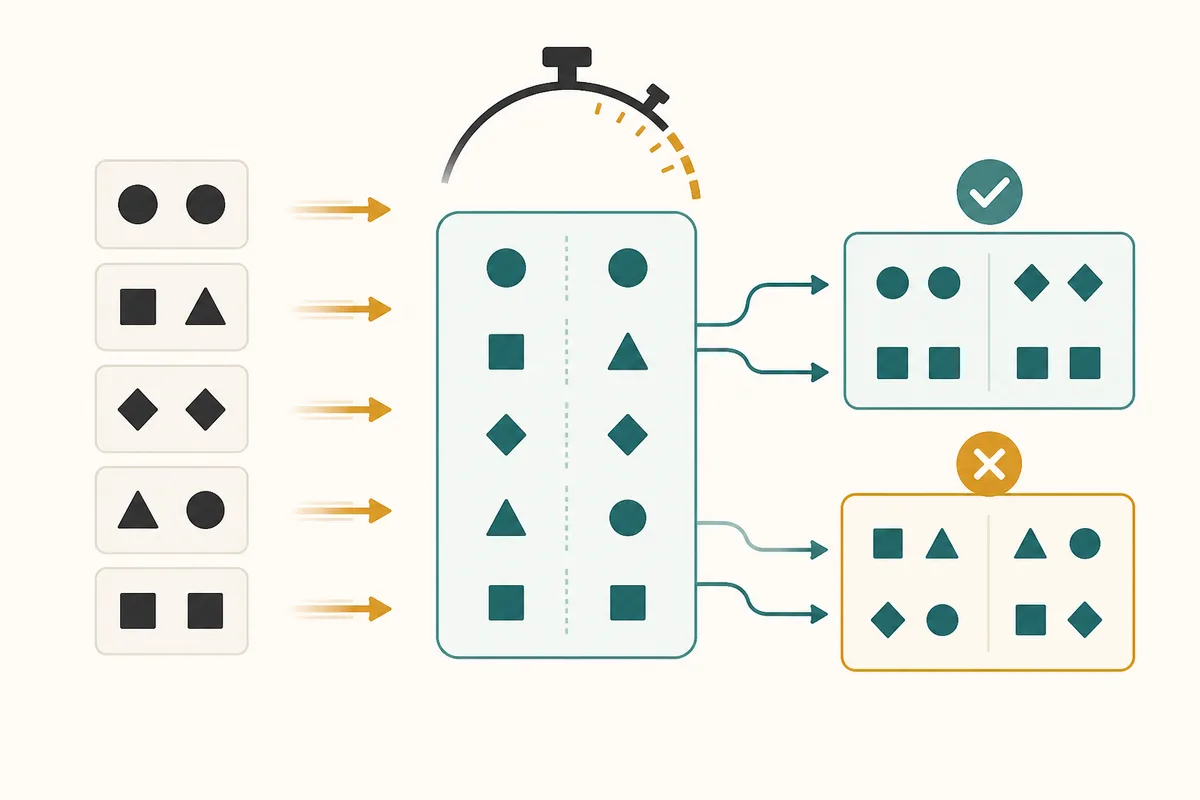
The second half is faster than the first, and here is what moved
The card reports a speed-up. It compares the middle time per item across the last third of your correct answers with the same figure from the first third.
Almost all of that gain is the key. Early on, every item costs you a trip to the top of the screen. By the end of ninety seconds you have used some pairings a dozen times, and those come back without a look. The trip stops happening for the digits you know and keeps happening for the ones you do not.
A small part is the pad. Your hand learns where the nine buttons are, in the same way it learns a keyboard. That is the part this task shares with average typing speed. There the same effect separates hunting for a key from knowing where it is.
A speed-up near zero is not a fault. It usually means the run opened quickly, which leaves less room to improve inside a single ninety seconds. A negative number means the last third was slower than the first, and tiredness is the usual reason.
- A large speed-up with a low count often means a slow start rather than a fast finish.
- A small speed-up with a high count is the profile of someone who arrived already warmed up.
- Accuracy below about 90% usually means the pad is being pressed before the key has been read.
No percentile here, and that is the honest version
The comparison block on this page draws no bar. There is no ranking, no percentile and no band. That is deliberate and it is worth explaining, because every other digit symbol test online will give you one.
This task has been measured properly for decades, and all of that measurement is of a pencil. The published distributions count symbols a person drew by hand in a fixed window, so the figure contains the speed of handwriting. Here you press one of nine buttons instead. The drawing is gone and a search of the pad has taken its place, and those are different amounts of work.
Nobody has published a distribution for the clicked version. Borrowing the pencil curve would look responsible and would read as a fact, and it would be neither. A median that is out by a third moves an ordinary run from the middle of the range to the bottom quarter. That is a confident wrong statement about a person.
So the page shows your number, your best and your own history, and says the ranking does not exist yet. For a figure that does sit against published data, what counts as a good reaction time is a better place to start. It also explains how much of any such number belongs to your equipment.
One thing about this task does survive the change from pencil to pad, and that is the shape of the age effect. Processing speed by age sets that shape out as percentages rather than counts. It also shows how far the age bands overlap, which is the part that stops a curve from being a ranking.
What a high count here is and is not
A high count says you ran a short lookup loop quickly, on this screen, on this day. The key was one you had never seen ninety seconds earlier. That is all it says.
It is not an intelligence score or a measure of how quickly you think in general. Practice will move the number, and what improves is this task. Getting quicker at matching digits to symbols makes you quicker at matching digits to symbols.
The published version is given on paper, while this page records performance in a browser. Those formats are not interchangeable.
Questions
What is a good score on this test?
There is no published figure for the clicked version, so there is no honest cut-off to quote. Most first runs land somewhere in the forties or fifties, and second runs are usually higher. Your own best over several attempts is the comparison worth having.
Is this the same as the paper test?
It is the same idea and not the same instrument. The clinical form is on paper, the symbols are drawn by hand, and it is given and interpreted by someone trained to do it. This is a browser version of the task, and it produces a number about this page only.
Why does the page not rank my score?
A rank needs a distribution, and the published ones all count symbols written with a pencil. Writing and pressing are different amounts of work, so those curves do not describe this task. Drawing a bar from them would give a confident answer to a question nobody has measured.
Why did my score jump on the second attempt?
Two things move on a second run. You know the shape of the task, which saves the first few seconds. You also know the pad, so your hand finds the buttons without hunting. The pairings themselves are reshuffled every run, so that part is never carried over.
Can I do it with the keyboard?
Yes. Each pad button carries a letter from A to I, laid out in three rows of three. Pressing that letter answers with that symbol. The letters are deliberately not digits, because a digit on the pad would be easy to confuse with the digit you are answering.
Why were some of my presses ignored?
A press that lands within 100 ms of a new digit cannot be an answer to it. Nobody reads a digit and finds its symbol that quickly. Those are treated as a press that bounced and are dropped. The result card says how many there were.
Do wrong answers cost me anything?
Not directly. The score counts correct substitutions and ignores the rest, so a wrong answer costs you the second it took and nothing more. Accuracy is reported next to the score, so a run that was fast because it was careless is visible on the card.
How is this different from the trail making test?
Trail making asks you to find the next item in a sequence you already know, so the work is search. Here the sequence is handed to you and the work is the lookup and the answer. One reports a time for a whole sheet, this one reports a count against a fixed clock.