Mental Rotation Test
Compare two block figures after one has turned and decide whether it shows the same shape or a mirror image.
Settings
Changing one restarts the attempt, and scores set under different settings are not comparable.
Quick start
- 1Press Play now. Two figures made of blocks appear side by side.
- 2Look at the left figure. The right one is the same figure, turned.
- 3Decide whether the right one is that shape or its mirror image.
- 4Press Same shape or Mirror image, or press S or M on the keyboard.
- 5Answer at your own pace. Nothing on the canvas is on a clock.
Loading test
How you compare
Extra time per quarter turn (s). Lower is faster. Reference distribution, not CognitiveDrill data.
The median for this test is 1.50 s. Take a run and your score appears on the bar.
Reference distribution, not CognitiveDrill data. It is shaped to match published results for this task and is replaced by our own norms once a cohort reaches n = 1,000. Shape based on: Shepard RN, Metzler J; Just MA, Carpenter PA; Vandenberg SG, Kuse AR.
Try next
About this test
A straight line from angle to seconds
Roger Shepard and Jacqueline Metzler put pairs of block figures in front of people in 1971 and timed the answers. What they found is one of the tidiest results in the whole of psychology.
The time to answer rose in a straight line with the angle between the two figures. A pair turned by 40 degrees took a fixed amount longer than an upright pair. A pair turned by 80 degrees took twice that much longer.
A line like that is hard to explain by looking. If people compared features one at a time, the angle would not matter in such an even way. It looks instead as though something is being turned, at a steady rate, until the two line up.
That is why the task is called mental rotation rather than mental comparison. The name is a claim about the method, and the straight line is the evidence for it.
This page reproduces the measurement rather than the story. It sets the angle itself. It times each answer from the frame the pair reached the screen, then fits a line through your times at each angle.
Why your number is a gradient
The headline here is the slope of that line, converted into something you can picture: the extra seconds a quarter turn costs you.
It is deliberately not a mark out of twenty. Almost everybody gets these pairs right, because there is no clock on the canvas and people slow down rather than guess. A score that everybody nearly maxes out tells you very little.
A gradient does not have that problem. It ignores how quick you are in general and asks only what the turning adds. Two people with the same total time can have very different lines through it.
The card carries the two ends of the line as well, so you can see where the number came from. One is your time on the upright pairs, which involves no turning at all. The other is your time on the half turns.
Only pairs you called correctly are timed. A wrong call is not a turn you finished. Including it would flatten the line with the trials where you gave up and guessed.
The published times at each angle are set out in mental rotation accuracy by angle. That page also explains why a share correct compares so badly from one version of this task to another.
Why turning never fixes a mirror image
Every figure here is a chain of cubes in three straight runs. Each run sits at right angles to the one before it.
That construction makes the shape handed, the way a left glove is handed. Hold a left glove up to a mirror and you see a right one. Turn the left glove any way you like and it stays a left glove.
So a mirror pair can never be settled by turning the figure far enough. Half the pairs here are the same shape and half are the opposite one, and no angle makes an opposite pair match.
The three faces of each cube are the same colour at three strengths. Nothing on the canvas is signalled by colour, so a visitor who cannot separate two hues loses nothing.
Both figures are drawn at the same size inside the same square box. A box that hugged the shape would shrink a diagonal figure, and its size would then answer the question before you had turned anything.
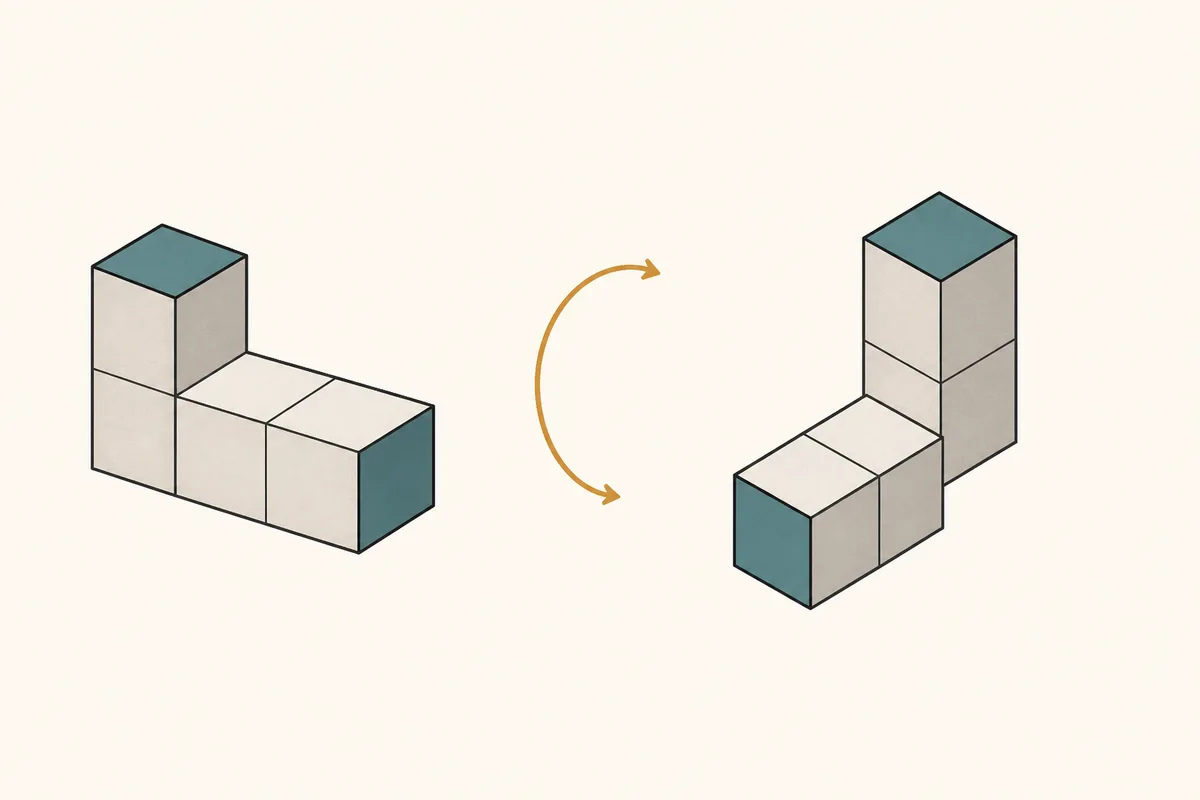
The turn happens in the plane of the screen
The right figure is turned within the flat of the screen, like a photograph rotated on a table. It is not tipped away from you into depth.
Shepard and Metzler ran both kinds and got the same straight line from each. A turn into depth is a harder drawing problem, and the flat turn measures the same rate. So the flat turn is what this page uses.
That has an honest consequence worth stating. Because both figures are the same drawing, a determined visitor can sometimes match one arm rather than turn the whole shape.
People do that in a laboratory too, and it shows up as a flatter line rather than as a broken measurement. If your gradient is very shallow and your accuracy is high, that is probably what you were doing.
The block count is a setting for the same reason. Longer arms give a shape with more to hold at once, which makes matching a single arm less useful.
Where the comparison figure comes from
The bar under your score is a reference distribution rather than our own data, and the page says so wherever it appears.
Its middle is the one number the original paper hands over. Shepard and Metzler put the average rate near sixty degrees a second, and ninety degrees at that rate is a second and a half.
The spread either side of that middle is a modelled shape. Marcel Just and Patricia Carpenter took the task apart in 1985 and found the gradient is where people differ. The quick end sits near a second a quarter turn and the slow end near three.
Nobody has published percentiles for a browser version of this task. The group test that does carry norm tables is scored as marks on paper. A mark on paper is not a gradient in milliseconds, so its figures do not transfer.
Our own norm replaces the model when a thousand runs have been recorded here, and not one run before that. The same rule governs every figure on the site, including how processing speed changes with age.
What a shallow line does not mean
A shallow line means you turned these particular block figures quickly today. It does not mean you have a good sense of direction or would be better at packing a car.
Spatial tasks look alike from outside and behave differently from each other. Folding paper, reading a map and turning a solid all draw on different things. That is why this hub will hold several tests rather than one.
Practice moves this number, and moves it fast. Most people take a chunk off their gradient over the first few runs simply by learning what the figures look like.
Whether that carries anywhere else is a separate question with a disappointing answer. There is more on it in whether brain training games are worth it.
Compare your recent runs with each other rather than your first run with somebody else's tenth. One run is a snapshot and a gradient from twenty pairs is a rough one.
Questions
What is a mental rotation test?
A test that shows two three-dimensional figures and asks whether one is the other turned, or its mirror image. The version here is the block-figure task Shepard and Metzler published in 1971.
What is a good mental rotation score?
On this page a good result is a small number, because the number is the extra time a quarter turn costs you. Around a second and a half is the middle of the reference curve.
Why does it take longer when the figure is turned further?
Because people appear to turn the shape in their head at a roughly steady rate. A bigger angle is a longer turn, so it costs more time. That relationship is the finding the test is built on.
Are the two figures ever exactly the same picture?
Yes. A pair turned by zero degrees that is not a mirror pair is the same drawing twice. Those pairs are the baseline, and your time on them is what the turning is measured against.
Why are only the pairs I got right timed?
A wrong call is not a completed turn. Timing it would mix your guesses in with your rotations and would flatten the line, which is the one thing the score is made of.
Does practice make you faster at this?
At this task, yes, and quite quickly. Whether it improves anything outside the task is contested and the honest summary is that gains rarely travel far.
Do men and women score differently on mental rotation tests?
This page cannot tell you. It runs one person at a time, holds nothing about who took it, and has no cohort to compare. Anything it said on the subject would be borrowed rather than measured.
Can I use this to practise for an aptitude test?
For the rotation items, yes. A full spatial paper also asks about folding, cross-sections and assembly, and none of those appear on this canvas.
Sources
- Shepard RN, Metzler J (1971). Mental rotation of three-dimensional objects. Science, 171(3972), 701-703. Link
- Just MA, Carpenter PA (1985). Cognitive coordinate systems: accounts of mental rotation and individual differences in spatial ability. Psychological Review, 92(2), 137-172. Link
- Vandenberg SG, Kuse AR (1978). Mental rotations, a group test of three-dimensional spatial visualization. Perceptual and Motor Skills, 47(2), 599-604. Link