Matrix Reasoning Test
Complete a nine-tile grid by following the rules that run across its rows and down its columns at the same time.
Settings
Changing one restarts the attempt, and scores set under different settings are not comparable.
Quick start
- 1Press Start. A grid of nine appears with the bottom right tile missing.
- 2Read along a row, then down a column. Work out what is changing.
- 3Pick the tile that completes the grid. Click it, or press 1 to 8.
- 4Read the line naming the rules that matrix was running.
- 5Press Next matrix. Every eight of them, another rule joins in.
Loading test
Why there is no comparison
Time to solve a matrix (s). Lower is faster. No published distribution exists for this task.
Every other test here draws your score on a bar of published results. This one cannot. Nobody has measured enough people on this task to say what a typical result is, so a bar here would be a picture of a number we made up.
Numbers for this task do circulate. The ones we could find name no study and do not agree with each other. We would rather show you nothing than repeat one of those.
No published distribution, and not CognitiveDrill data either. Nobody has measured this task on a large enough sample to say what a typical result is, so this page shows your number and does not rank it. Our own norm is published once a cohort reaches n = 1,000.
Try next
About this test
What a tile is made of
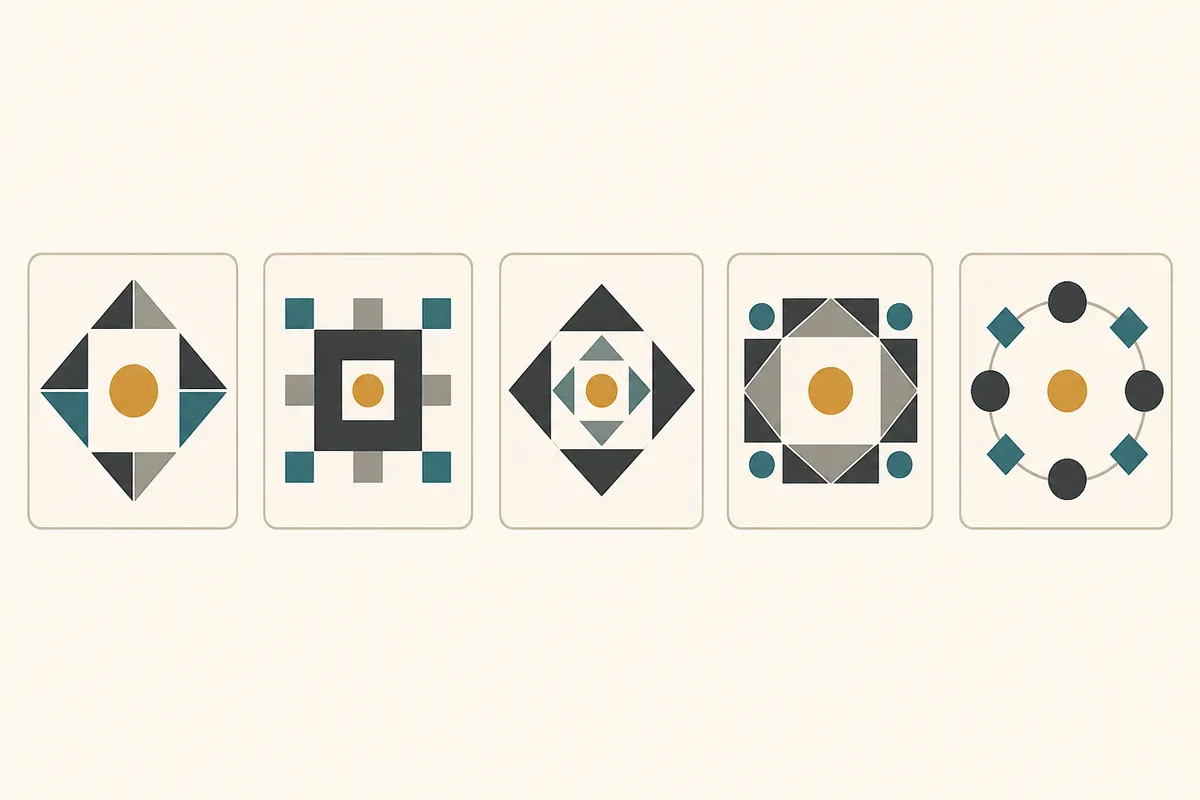
Every cell in the grid holds one tile, and a tile carries three properties. There is nothing else in there.
That closed set is what makes the puzzle answerable rather than a guess at what the author had in mind. You are never hunting for what to look at. You are working out which property a rule has hold of, and what the rule is doing to it.
- Shape. A circle, a square or a triangle.
- How many. One, two or three copies of the shape.
- Fill. Hollow, half filled or solid, with nothing in between.
A row and a column are two different readings
A rule works on one property, and there are three things it can do with it.
The first two are the reason a grid is not a strip. A rule held across the rows is answered by looking along the bottom row. It is not answered by looking down the right hand column. The tile that fits the column alone is one of the eight on offer.
So a property under one of those rules always has a value repeated. Three different values over three cells would be readable in either direction, and the two rules would stop being two rules.
Carpenter, Just and Shell took the paper version apart in 1990. What separated people was not spotting a rule. It was carrying one part-finished rule while checking the next.
- Held still across a row. The three tiles in a row share the value, and the rows differ.
- Held still down a column. The three tiles in a column share it, and the columns differ.
- One of each, everywhere. Each of the three values appears once in every row and once in every column.
Twenty-four matrices, in the same order for everybody
The ladder is fixed and it does not adapt to you. Eight matrices with one rule running, then eight with two, then eight with three.
Nothing stops you early. A miss costs you that matrix and not the rest of the run, and there is no clock over any of it. That is the opposite arrangement to the abstract reasoning test, which puts one clock over the whole paper and ends it wherever you are.
Every matrix offers eight tiles. One completes the grid and seven do not, and most of the seven are wrong in exactly one property. A guess is right one time in eight, so a run answered blind lands near three.
Both settings change what the number means. Twelve matrices is half the evidence, and four tiles to choose from makes a guess right one time in four. Neither run is comparable with the default one.
Why the number is a time
Nothing here is timed against you, so the time is a thing to measure rather than a thing to impose. It is the median across the matrices you got right.
Time spent on one you got wrong is time you gave up on rather than time to an answer. Folding it in would let a run of quick confident mistakes read as quick reasoning.
That leaves one thing the median hides, so the card carries it alongside. A fast time off two solved is not a fast time off twenty, and the share you solved is on the same card.
The third figure is how much longer the three rule matrices took you than the one rule ones. That one counts every matrix at both rungs, right or wrong, because it is about the load rather than the outcome.
For a number that does have a real distribution behind it, processing speed by age has one.
Why there is no percentile under your time
Nobody has published a distribution of how long people take on matrices we generated ourselves. So there is not one on this page.
Raven's tables are real and they do not fit. They describe raw scores on sixty of his own items, on paper, mostly under supervision and mostly decades ago. Hanging our seconds on that curve would be an invented number wearing a citation.
Carpenter and colleagues did time people on matrices. Their items were Raven's and their sample was small, which makes it a finding rather than a norm.
Matzen and colleagues later built software to generate Raven-like matrices with measured properties, which is the same idea as this page. Their figures describe their items, not ours.
Our own norm goes up when a cohort here reaches a thousand runs, and not one day before that.
The claim this page will not make
Matrix puzzles are the best known item type on intelligence batteries, and that is the whole reason this section exists. Appearing on one does not make this page one.
No time here has been checked against any measure of intelligence. Nobody has run that study on these items, so a claim in that direction would be made up.
Published subtests have their own items, administration rules and comparison tables. Those results are not interchangeable with this browser task.
The time describes how quickly you solved these matrices today.
Practice here makes you quicker at these three rules on these tiles. Researchers call that near transfer, and whether brain training games are worth it covers what happened when the wider claims were tested.
Questions
What is a good time on a matrix reasoning test?
There is no published distribution for these matrices, so we will not invent one. Read your time next to the share you solved, because a fast time off a handful of solves is not a fast time.
Is this an IQ test?
No. Matrix puzzles sit on intelligence batteries, which does not make this one. No time on this page has been checked against any measure of intelligence.
Why does a wrong answer not end the run?
Because the ladder is fixed rather than adaptive. Everybody sees the same twenty-four in the same order, and a miss costs you that matrix alone.
How do I know which direction a rule runs in?
You do not until you check. A rule held across the rows is settled by the bottom row, and one held down the columns by the right hand column.
Why do two tiles in the grid sometimes look the same?
Because two rows or two columns can share a value. Three different values over three cells would make every rule readable in either direction, which would make the directions pointless.
What is the extra time figure on the card?
It is how much longer a three rule matrix took you than a one rule one. It counts every matrix at those two rungs, whether you answered it correctly or not.
Does it work with a screen reader?
Yes. Every tile is named by position and content, such as top left, two hollow squares. The eight answers take the 1 to 8 keys.
Sources
- Carpenter PA, Just MA, Shell P (1990). What one intelligence test measures: a theoretical account of the processing in the Raven Progressive Matrices Test. Psychological Review, 97(3), 404-431. Link
- Raven J (2000). The Raven's Progressive Matrices: change and stability over culture and time. Cognitive Psychology, 41(1), 1-48. Link
- Matzen LE, Benz ZO, Dixon KR, Posey J, Kroger JK, Speed AE (2010). Recreating Raven's: software for systematically generating large numbers of Raven-like matrix problems with normed properties. Behavior Research Methods, 42(2), 525-541. Link