Pattern Recognition Test
Find the hidden rule across six tiles and choose the seventh as each new level adds another rule to follow.
Settings
Changing one restarts the attempt, and scores set under different settings are not comparable.
Quick start
- 1Press Start. Six tiles appear in a row with the seventh missing.
- 2Look for what changes from tile to tile. Shape, fill, how many, how big.
- 3Pick the tile that comes next. Click it, or press 1 to 4.
- 4Read the line naming the rules that strip was running.
- 5Press Next level. The one after it adds another rule.
Loading test
Why there is no comparison
Highest level cleared (of 6). Higher is better. No published distribution exists for this task.
Every other test here draws your score on a bar of published results. This one cannot. Nobody has measured enough people on this task to say what a typical result is, so a bar here would be a picture of a number we made up.
Numbers for this task do circulate. The ones we could find name no study and do not agree with each other. We would rather show you nothing than repeat one of those.
No published distribution, and not CognitiveDrill data either. Nobody has measured this task on a large enough sample to say what a typical result is, so this page shows your number and does not rank it. Our own norm is published once a cohort reaches n = 1,000.
Try next
About this test
The four things a tile can change
A tile here carries four properties and no others. That closed set is deliberate, and it is what turns a guessing game into a puzzle you can actually solve.
You are never hunting for what to look at. You are working out which of the four is moving, and how many tiles it takes to come back round.
- Shape. A circle, a square, a triangle or a diamond.
- Fill. Solid or hollow, with nothing in between.
- How many. One, two or three copies of the shape in the tile.
- How big. Small, medium or large.
What each level adds
There are six levels, and each runs more rules at the same time. A rule gives one property a cycle, such as circle, square, diamond and back to circle.
- One property alternating between two values.
- One property cycling through three.
- Two properties, on cycles of three and two.
- Two properties, on cycles of four and three.
- Three properties at once, on cycles of four, three and two.
- Four properties at once, on cycles of four, three, three and two.
Why the last level is the hard one
By level six no two tiles in the strip are alike. Matching a whole tile against one you have already seen stops working, and each property has to be read on its own.
Simon and Kotovsky put numbers on that in 1963. What predicted how often people got a sequence wrong was the number of rules running at once. The length of the cycle mattered as well. How clever the shapes looked did not.
Holzman and colleagues found the same thing again on series completion twenty years later. So the ladder is built out of the two things the research says actually make this harder.
Anything no rule touches holds still for the whole strip. A property that changes is therefore always part of the answer, and one that does not is never a red herring.
Why the level number has no percentile
The ladder is ours. We chose the six levels and we chose the cycles, and nobody has measured a thousand people on this exact arrangement.
Published norms for sequence puzzles do exist, and none of them fits. Raven's tables describe raw scores on the Progressive Matrices, a different test with a different answer set. Hanging our levels on that curve would be an invented number wearing a citation.
What you can check instead is the arithmetic. Every question offers four tiles, so a guess is right one time in four. On two tries a level falls to a guesser about 44 per cent of the time. All six falling that way happens about seven times in a thousand.
For a number that does have a real distribution behind it, what counts as a good digit span has one.
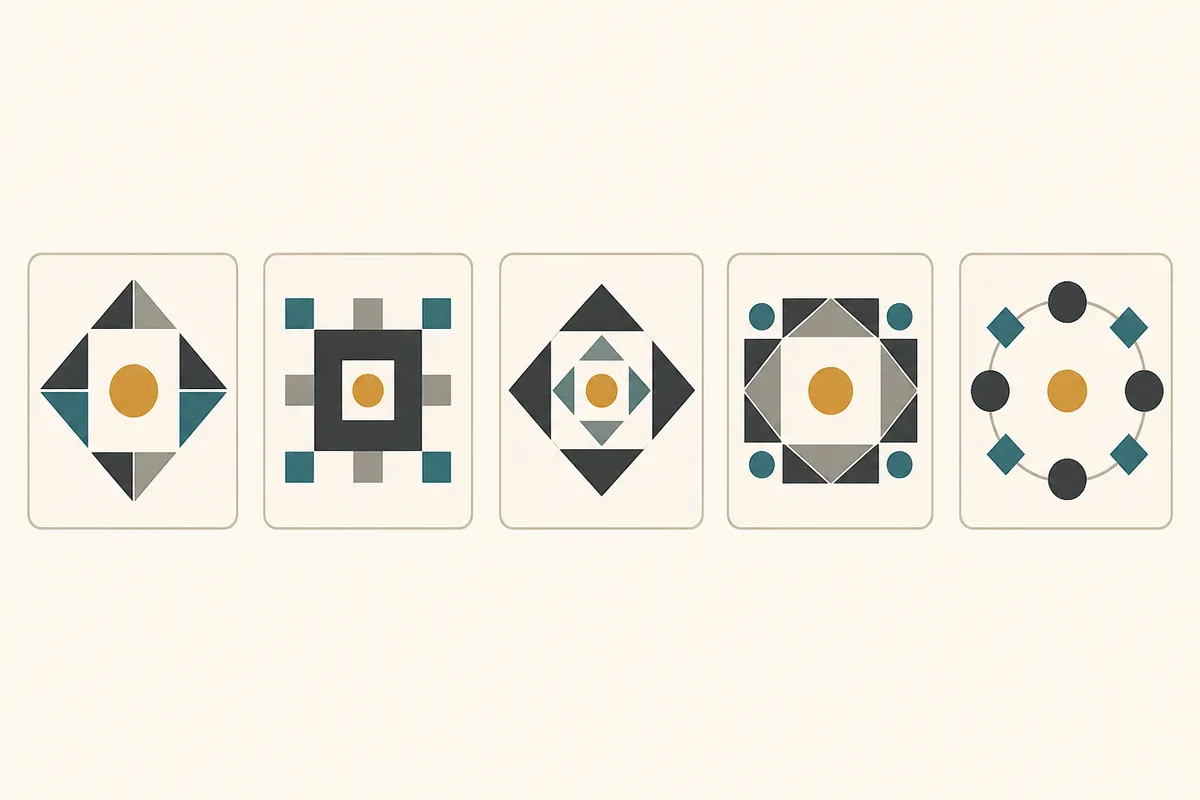
Strips and grids are not the same puzzle
This page gets confused with a matrix test, and the two ask for different work.
The matrix reasoning test lays out a three by three grid with the bottom right cell missing. Rules run across the rows and down the columns at once, and the answer comes from eight options rather than four.
Carpenter, Just and Shell took that test apart in 1990. What separated people was not spotting a rule. It was holding several part-finished goals in mind while checking the next one.
A strip runs in one direction only, so there is far less to hold. This is the simpler machine, on purpose, and the level you reach here says nothing about the grid version.
Why this is not an intelligence test
Sequence puzzles turn up on intelligence batteries, and that is the whole reason this section exists. Appearing on one does not make this page one.
No score here has been checked against any measure of intelligence. Nobody has run that study on this item set, so a claim in that direction would be made up.
The level describes how far you progressed through this task today.
What the number is: the hardest arrangement of rules you worked out today, on our ladder, in a browser.
What ends a run early
A run stops at the first level you cannot clear. One lapse can therefore end it well below what you would have managed on a better minute.
The settings exist for that. Two tries at each level is the default and forgives a single slip. One try makes the ladder strict, and scores from the two are not comparable.
The time limit is the other lever. Leave it off and you can stare at a strip for as long as you like. The median time on the result card still records how long you took.
Any measurement taken once has this problem. The piece on what a good reaction time is makes the case with a number that has been measured properly.
Questions
What is a good score on a pattern recognition test?
There is no published distribution for this ladder, so we will not invent one. Guessing clears a level about 44 per cent of the time on two tries, and that is the only benchmark we can stand behind.
Is this an IQ test?
No. Sequence puzzles appear on intelligence batteries, which does not make this one. No score here has been checked against any measure of intelligence.
How is this different from a matrix or Raven puzzle?
A matrix runs rules across a grid in two directions and offers eight answers. This runs one strip in one direction and offers four.
What are the tiles actually showing?
Four properties and nothing else. The shape, whether it is solid or hollow, how many copies there are, and how big they are.
Why did my run stop so early?
Because every try at that level was wrong. Two tries is the default, and switching to one try ends a run on a single miss.
Does the time limit change the level I reach?
It can. A limit turns a pattern you would have solved slowly into a miss, and a miss is what ends the run.
Will practice push me higher?
Probably, and what improves is your reading of this particular set of rules. Nothing here shows that it carries anywhere else.
Does it work with a screen reader?
Yes. Every tile is labelled in words, such as two large hollow squares, and the four answers take the number keys 1 to 4.
Sources
- Simon HA, Kotovsky K (1963). Human acquisition of concepts for sequential patterns. Psychological Review, 70(6), 534-546. Link
- Kotovsky K, Simon HA (1973). Empirical tests of a theory of human acquisition of concepts for sequential patterns. Cognitive Psychology, 4(3), 399-424. Link
- Holzman TG, Pellegrino JW, Glaser R (1983). Cognitive variables in series completion. Journal of Educational Psychology, 75(4), 603-618. Link
- Carpenter PA, Just MA, Shell P (1990). What one intelligence test measures: a theoretical account of the processing in the Raven Progressive Matrices Test. Psychological Review, 97(3), 404-431. Link