Abstract Reasoning Test
Find the figure that breaks the shared rule across twenty sets while one clock runs through the whole test.
Settings
Changing one restarts the attempt, and scores set under different settings are not comparable.
Quick start
- 1Press Start. Five figures appear in a row and the clock begins.
- 2Four of them keep one rule. Work out which rule that is.
- 3Pick the figure that breaks it. Click it, or press 1 to 5.
- 4Read the line naming the rule, then press Next set.
- 5Keep going until the twenty sets or the clock run out.
Loading test
Why there is no comparison
Figures placed correctly (of 20). Higher is better. No published distribution exists for this task.
Every other test here draws your score on a bar of published results. This one cannot. Nobody has measured enough people on this task to say what a typical result is, so a bar here would be a picture of a number we made up.
Numbers for this task do circulate. The ones we could find name no study and do not agree with each other. We would rather show you nothing than repeat one of those.
No published distribution, and not CognitiveDrill data either. Nobody has measured this task on a large enough sample to say what a typical result is, so this page shows your number and does not rank it. Our own norm is published once a cohort reaches n = 1,000.
Try next
About this test
The four rules a set can run
A set is built on one rule and one only, and there are four of them. They are listed here because a puzzle where the rule could be anything is not a test of reasoning. It is a guess at what the author had in mind.
- The same number of filled squares. Four figures share a count and one does not.
- A mirror image down the middle. Four figures are symmetrical and one is not.
- No two filled squares touching. Four figures keep every square apart and one has a pair side by side.
- Nothing in the middle. Four figures leave the centre clear and one does not.
Why the other three things are held still
Within a set, only the rule varies. If the rule is the count, then every one of the five figures is equally lopsided, equally crowded, and equally busy in the middle.
Without that, an item can have two right answers. One figure could be the only symmetrical one while another is the only one with a filled centre, and both readings would be defensible.
That is the flaw in a lot of free puzzle pages, and it is invisible until you argue with one. Here the four features are checked against every figure in the set before it is shown.
It also makes the reason line honest. The rule named after your answer is the rule the set was built on, not a rule fitted to it afterwards.
The clock is the format, not the finding
Graduate schemes give you a fixed paper and a fixed number of minutes, so this page does the same. Twenty sets, five minutes by default, and a running count of how many you have right.
That makes the score two things at once. It is how many you could place, and it is how many you got through. Both are on the result card, because a score of nine from ten attempts is a different result from nine from twenty.
Turning the clock off is the practice mode. It is the honest way to learn what the four rules look like, and the number it produces cannot be compared with a timed run.
Bethell-Fox, Lohman and Snow watched where people looked during figure problems. What separated them was how they searched, not how fast they could move their eyes.
Strips, grids and sets are three different puzzles
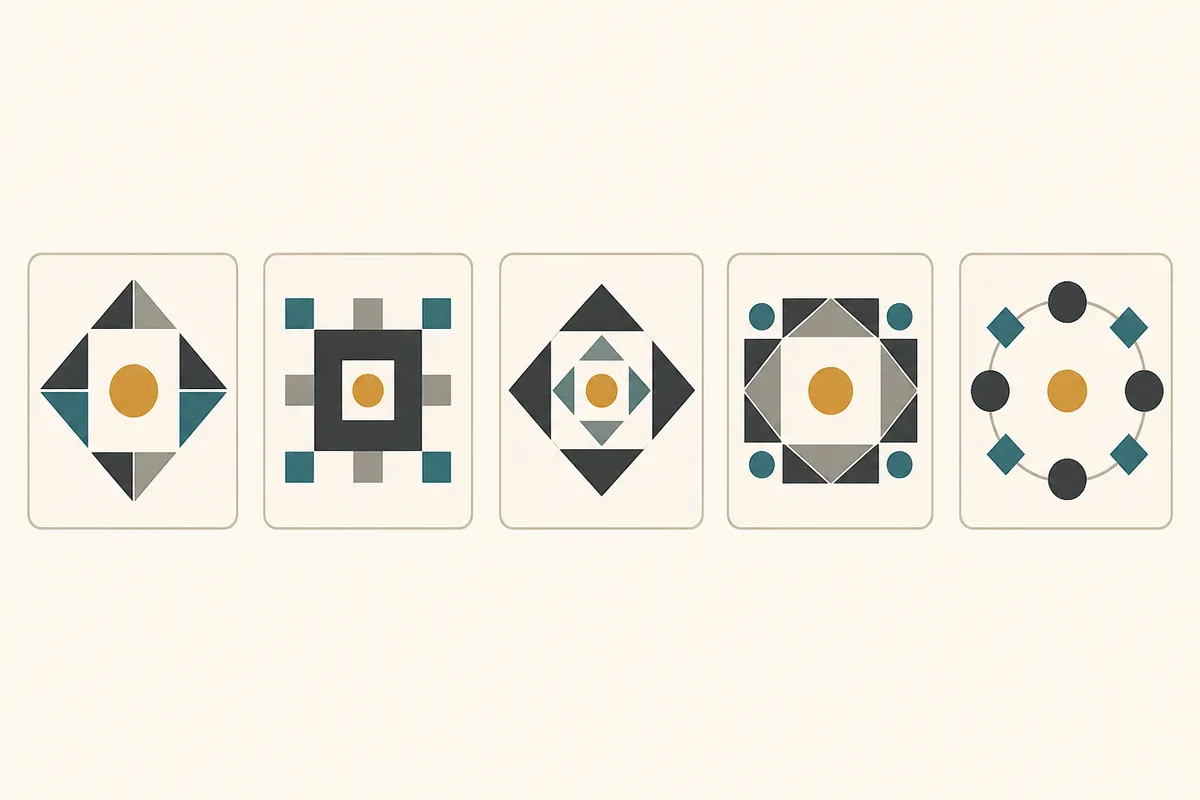
This page asks which figure is wrong. That is a different question from what comes next, and different again from what fills the gap in a grid.
The pattern recognition test runs a strip of six tiles and asks for the seventh. It ladders up through more rules at once and it has no clock.
The matrix reasoning test lays out a three by three grid with one cell missing. Rules run across the rows and down the columns at once. Carpenter, Just and Shell showed the difficulty there comes from holding part-finished goals in mind.
An odd-one-out set is the flattest of the three. Every item is worth the same, there is nothing to hold between items, and the pressure comes from the clock instead.
Why the score is not a percentile
These are our figures, our four rules and our clock. Nobody has measured a thousand people on this exact arrangement, so a percentile would be an invented number.
Test publishers do report norm groups for their own abstract reasoning papers. Those tables describe one publisher's items, sat under supervision, by the people who applied to those schemes that year. None of that transfers to a browser tab.
What you can check is the arithmetic. Five figures means a guess is right one time in five, so a run of twenty answered at random lands near four.
For a number that does have a distribution behind it, processing speed by age shows what one looks like when it is real.
What practice on this page is worth
It is worth what practice is always worth. You get quicker at these four rules, on these figures, in this layout. That is a real thing to gain before a test in a similar format.
It does not spread further than that on its own. Researchers call the narrow kind of gain near transfer, and do brain training games work covers what happened when the wider claims were tested.
It is not a measure of intelligence. Nothing here has been checked against any measure of intelligence, and no score on this page is a claim about one.
It is not a prediction about a job either. This page cannot tell you whether you will pass an employer's paper. That paper has its own items, its own clock and its own pass mark.
The result stays specific to these puzzles. How working memory works is the nearest thing to an explanation of the load these puzzles put on you.
Questions
What is a good score on an abstract reasoning test?
There is no published distribution for this set, so we will not invent one. Guessing every answer lands near four out of twenty, and that is the only benchmark we can stand behind.
Is this the same as an IQ test?
No. Figure puzzles appear on intelligence batteries, which does not make this one. No score here has been checked against any measure of intelligence.
How many rules are there?
Four, and they are all listed on this page. A set runs exactly one of them, and the other three are held constant across the five figures.
Why did the clock end my run early?
Because the clock covers the whole paper rather than each set. Your score and the number of sets you reached are both on the result card.
Should I practise with the clock off?
It is the sensible way to learn the four rules. A run with no clock is not comparable with a timed one, so treat them as two different numbers.
Will this help with a graduate scheme test?
It can make the format familiar, which is worth something. It cannot tell you how you will do on a particular employer's paper.
What does four by four change?
There are more squares to read and more ways for a rule to hide, so the same rules take longer to spot. The two sizes are not comparable.
Does it work with a screen reader?
Yes. Each figure is described by which squares are filled, such as top left and middle centre. The five answers take the 1 to 5 keys.
Sources
- Bethell-Fox CE, Lohman DF, Snow RE (1984). Adaptive reasoning: componential and eye movement analysis of geometric analogy performance. Intelligence, 8(3), 205-238. Link
- Carpenter PA, Just MA, Shell P (1990). What one intelligence test measures: a theoretical account of the processing in the Raven Progressive Matrices Test. Psychological Review, 97(3), 404-431. Link
- Simon HA, Kotovsky K (1963). Human acquisition of concepts for sequential patterns. Psychological Review, 70(6), 534-546. Link