Spatial Ability Test
Complete three kinds of spatial question and see which one costs you the most marks.
Settings
Changing one restarts the attempt, and scores set under different settings are not comparable.
Quick start
- 1Press Play now. A picture appears with four answers under it.
- 2Read the question above the picture. It is not the same every time.
- 3Pick an answer with a click, or press A to D on the keyboard.
- 4Read the line that comes back. It says what the answer was.
- 5Press Next item. Twelve items, and nothing on a clock.
Loading test
Why there is no comparison
Items you got right (%). Higher is better. No published distribution exists for this task.
Every other test here draws your score on a bar of published results. This one cannot. Nobody has measured enough people on this task to say what a typical result is, so a bar here would be a picture of a number we made up.
Numbers for this task do circulate. The ones we could find name no study and do not agree with each other. We would rather show you nothing than repeat one of those.
No published distribution, and not CognitiveDrill data either. Nobody has measured this task on a large enough sample to say what a typical result is, so this page shows your number and does not rank it. Our own norm is published once a cohort reaches n = 1,000.
Try next
About this test
Three questions in one paper
A spatial ability test in a book of aptitude papers is never one task. It is a set of them, and the mark at the end is the share you answered correctly.
This page keeps that shape. Three kinds of item run in a fixed order, four of each, so everybody meets the same mix in the same places.
The first shows a stack of cubes and asks how many cubes are in it, including the ones behind the ones you can see.
The second shows a stack and asks which of four flat pictures is that stack seen from the front.
The third shows four sheets of six squares. One of them closes into a cube and the other three jam.
Nothing is on a clock. The paper asks what you can work out, not how quickly you can work it out. Each of the three kinds is scored on its own as well as into the total.
The cubes behind the cubes
You can see three faces of a cube from this angle: the top, the face to the right and the face to the left. A cube with all three covered is invisible.
Every stack on this page is built so that at least one cube is in that position. Counting what is drawn is therefore always the wrong answer.
It is also an answer on offer. One of the four numbers under each stack is exactly the number of cubes you can see. A count that stops at the surface lands on it.
The floor under the stack is drawn as a faint grid. A square with nothing on it is a gap rather than a mistake, and a gap lets you see further into the pile.
Most people undo the pile column by column, holding a running total while they work out the next one. That is the same shortage of room the number span tests measure. The sizes are in a similar range: see what a good digit span looks like.
A stack has more than one honest picture
The view item asks for an elevation, which is what the stack looks like flattened against a wall behind it.
The rule is that the tallest column in each line sets the height of that line. A single tall column at the back shows up in the view even when everything in front of it is low.
The obvious miss is to read the front row and stop. That picture is one of the four answers, so the miss has somewhere to land rather than being caught by luck.
The view from the right-hand side is usually there too. It is a real reading of the same stack and a wrong answer to the question asked, which is the most useful kind of distractor.
All four pictures are drawn at one scale, in the same box, with the same number of columns. Nothing about their size or position hints at which one is right.
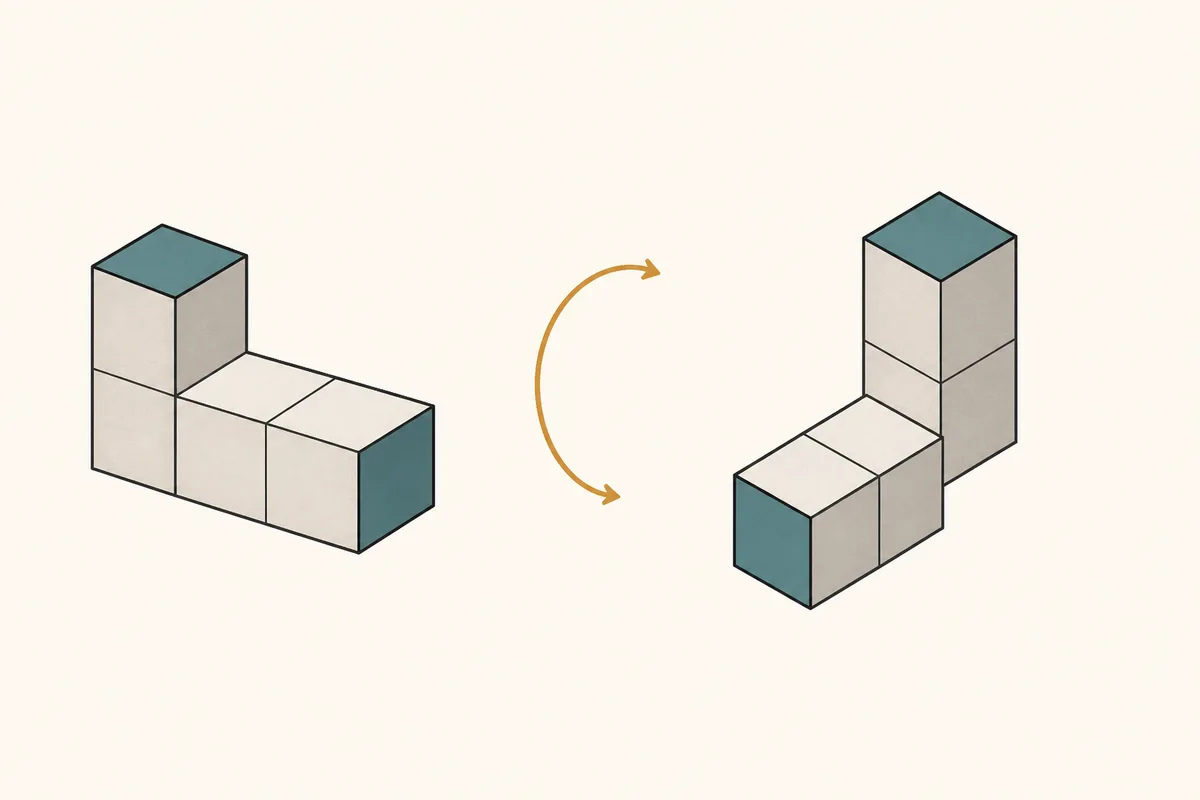
Eleven sheets in thirty-five close
There are 35 ways to join six squares edge to edge. Eleven of them fold into a cube and the rest fold onto themselves.
Two failures are common enough to be worth knowing. A sheet holding a two by two block always jams. The fourth square of that block wants a face that two of its neighbours have already taken.
The other is a row of four with both flaps on the same side. The row wraps into a band around the cube, and the two flaps then compete for the top, leaving the bottom open.
Every wrong sheet here is one of those two, drawn at a random turn and flip. So a sheet cannot be ruled out by how tidy it looks, only by folding it.
This is not the folding task next door. That one punches a hole through a folded sheet and asks where the holes land. This one closes a box, and the two questions come apart in the mark.
Why a quarter of the marks are free
Every item offers four answers, so a paper answered by tossing a coin scores about 25 per cent. That is the floor, and it is the first thing to know about the number.
A result near it is not a low score. It is a run with no information in it, and the honest reading is that the answers came from somewhere other than the pictures.
The choice of four is deliberate. Fewer answers lift the floor and more of them turn the item into a search through the options rather than a piece of visualising.
Twelve items is a coarse ruler as well. One item is worth eight points, so two runs a fortnight apart can differ by that much without anything having changed.
The longer setting halves that step. It is the one to use if you want to compare two runs rather than simply take the paper once.
The card splits the mark three ways for the same reason. A single figure cannot tell a visitor who cannot see hidden cubes from one who cannot fold a net, and those are different problems.
No bar under the number, and why
Most pages here put your result on a curve. This one shows the number by itself, because the curve that would fit it does not exist.
Published spatial batteries have norm tables, and every one of those tables belongs to its own paper. They differ in the item set, the number of items, the time limit and whether wrong answers are corrected for guessing.
A percentage only means something against the exact paper it came from. Stretching one of those tables over this one would be an invented figure wearing a real citation.
A time travels further than a mark does. The rotation task next door reports one, and the published figures behind it are in mental rotation accuracy by angle.
There is a deeper reason to be careful with a single spatial number. Factor studies keep finding that spatial ability breaks into parts, and that the parts do not move together in one person.
Practice moves this mark, and it moves it quickly. Whether that carries anywhere outside spatial tasks is contested, and the honest summary is in what the evidence on brain training says.
Our own norm goes up when a thousand runs have been recorded here, and not one run before that. The same rule governs every figure on this site.
Questions
What is a spatial ability test?
A paper of items about shapes in space, usually mixed rather than all of one kind. This one runs cube counting, elevations and cube nets, and reports the share you answered correctly.
What is a good spatial ability test score?
Nobody has published a distribution for this exact paper, so it will not tell you what is typical. What it can tell you is that four answers an item put a floor near 25 per cent under everybody.
Is this the same as a spatial reasoning test?
The words are used for the same family of tasks. This page is the mixed paper, and the hub above it lists the single-task tests that make up the family.
Why do the questions keep changing?
Because a battery is a mix by definition. Three kinds of item rotate through the run, and the result card scores each kind on its own as well as scoring the paper.
How am I supposed to count cubes I cannot see?
By working out the shape of the pile rather than the picture of it. A column that holds a cube on top must hold cubes under it, because nothing in these stacks floats.
Can more than one of the four sheets fold into a cube?
No. Exactly one sheet in each net item closes, and the other three come from two families of shape that always jam. The build fails if that ever stops being true.
Can I use this to prepare for an aptitude test?
For these three item kinds, yes. A full paper often adds rotation, cross-sections and assembly, and the first of those has its own page in this hub.
Does practising this improve my spatial ability?
It improves your mark on these items, and fairly quickly. Training studies find gains that reach other spatial tasks, and how far beyond those they travel is still argued over.
Sources
- Ekstrom RB, French JW, Harman HH, Dermen D (1976). Manual for Kit of Factor-Referenced Cognitive Tests. Princeton NJ: Educational Testing Service. Paper Folding is test VZ-2. Link
- Carroll JB (1993). Human Cognitive Abilities: A Survey of Factor-Analytic Studies. Cambridge: Cambridge University Press. Chapter 8 covers the visual perception factors. Link
- Linn MC, Petersen AC (1985). Emergence and characterization of sex differences in spatial ability: a meta-analysis. Child Development, 56(6), 1479-1498. Link
- Uttal DH, Meadow NG, Tipton E, Hand LL, Alden AR, Warren C, Newcombe NS (2013). The malleability of spatial skills: a meta-analysis of training studies. Psychological Bulletin, 139(2), 352-402. Link