Audio Memory Test
Listen to a melody without visual hints, tap it back on the pads, and find the longest sequence you can remember.
Settings
Changing one restarts the attempt, and scores set under different settings are not comparable.
Quick start
- 1Put headphones on, or turn your speakers up a little.
- 2Press Start. A melody plays and nothing on screen moves.
- 3Tap the pads back in the order you heard them. The lowest note is on the left.
- 4Use the number keys instead if you prefer. Pad one is the lowest.
- 5Keep going. Every melody you clear comes back one note longer.
Loading test
How you compare
Tone span (tones). Higher is better. Reference distribution, not CognitiveDrill data.
The median for this test is 5 tones. Take a run and your score appears on the bar.
Reference distribution, not CognitiveDrill data. It is shaped to match published results for this task and is replaced by our own norms once a cohort reaches n = 1,000. Shape based on: Williamson VJ, Baddeley AD, Hitch GJ; Cowan N; Miller GA.
Try next
About this test
Why nothing lights up while the melody plays
The sequence memory test lights each square as it plays. Watch that and the sequence arrives as a list of places, which is why it measures what your eyes kept hold of.
Light a pad here and exactly the same thing would happen. The melody would become a row of flashes, you would remember the flashes, and the notes would be decoration on top of a visual task.
So the pads stay dark. A note sounds, and the only way to know which pad it came from is to hear how high it was. That conversion is part of the job, and it is the part that makes this an audio number rather than a visual one.
It also makes the test unusually forgiving about equipment. Each pitch is computed rather than recorded, so a cheap speaker plays it at exactly the right frequency. Only the volume changes, and volume is not what you are being asked about.
A tone is harder to hold than a digit
Read someone seven digits and most people can say them straight back. Play seven notes and almost nobody can. The gap is large, and musical training closes very little of it.
A digit has a name. You say it under your breath, and the sound of your own voice keeps it alive for a few seconds. That rehearsal loop is most of what a digit span measures, and how working memory works walks through the machinery. The figures themselves sit on what counts as a good digit span.
A note has no name unless you gave it one, and very few people did. The trace has to survive as a pitch rather than as a word, and pitch traces fade faster and get in each other's way.
Deutsch showed that interference directly in 1970. Fill the gap after a tone with spoken numbers and the tone survives. Fill it with other tones and it does not. Two stores, doing two jobs, sitting side by side.
So a tone span of five is not a poor digit span. It is a different measurement, and there is no exchange rate between the two.
Where in a melody people actually slip
The card reports the average position of your mistakes, and it is often the more interesting of the two figures.
Slips cluster in the middle. The first note is protected because nothing was competing with it when it arrived. The last note is protected because it is still ringing when your turn starts. The notes between have neither advantage.
That shape turns up in almost every list task ever run. Finding it in your own three or four slips proves nothing. Finding it across a dozen runs is a different matter.
Slips at note one mean something else is wrong. Either the melody starts before you have settled, or the pace is quicker than you can follow. Slow it down and take it again.
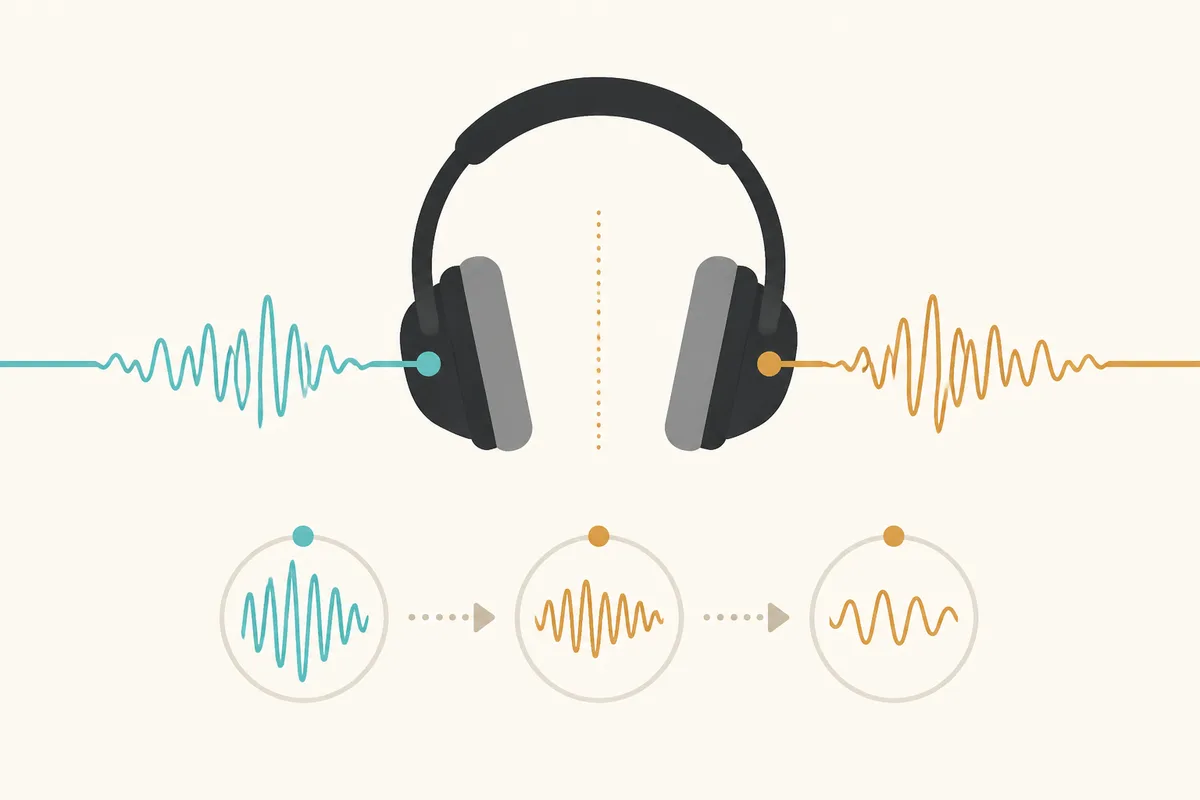
The pads are a ladder, and the ladder is a shortcut
Four pads laid out low to high hand you a rough naming scheme. Top, upper middle, lower middle, bottom. That is nothing like absolute pitch, and it is a long way from nothing.
It is why the reference curve here sits above the plain capacity figure for material you cannot name. Cowan puts that near four items. Miller's famous seven belongs to material you can put words to. A tone ladder sits between the two, and so does the curve.
Close the pads up and the shortcut stops working. The narrow setting squeezes the whole set inside a fifth. Telling the third pad from the fourth becomes a pitch judgement rather than a glance at a shape. Most people lose a note or two.
Widen the pads again and add more of them instead. Six notes across an octave and a half are easy to tell apart and hard to keep in order. The two settings break the task in different places, which is why both are here.
- Fewer pads, wide apart: the easiest setting, and the one the reference curve is drawn for.
- More pads, wide apart: the notes stay easy to name and the order gets crowded.
- Any number of pads, close together: naming fails first, and the order barely matters.
What a number between two and twelve does not settle
A span is a snapshot. It moves with sleep, with the noise in the room, and with how many melodies you have already sat through today. One run is a data point rather than a verdict.
It is not a musical ability score either. Plenty of trained musicians land in the middle here, and plenty of people who have never played anything do well. Getting better at this page means getting better at this page.
The number describes how many tones you held in order during this run.
Questions
What is a good score on the audio memory test?
Five notes sits in the middle of the reference curve for four pads. Three is common on a first run and eight is a strong result. The curve is a model rather than our own data, so read it as a rough placing.
Why does the melody stop the moment I press the wrong pad?
Because every press after a wrong one is being scored against a note you are no longer lined up with. The attempt is finished, so the tool says so and gives you a second melody at the same length.
Is this the same as the sequence memory test?
No. That one lights the square it is playing, so the sequence arrives as places on a grid. Nothing lights here, and the note itself is the only clue to which pad it came from.
Can I hum the melody back while I press?
Nothing stops you and it usually helps. It is the same trick that makes digits easier than tones, and it is part of why the pads run low to high.
Why does a melody never play the same note twice in a row?
Two identical notes in a row sound like one longer note. You would have heard the melody correctly and still entered the wrong number of presses.
Does musical training help?
On average, yes. Trained listeners hold a note or two more than untrained ones in published comparisons of tone sequences. The gap is real and it is smaller than most people expect.
Do I need headphones for this?
No. Each pitch is exact through any speaker, so only the volume and the noise around you matter. Headphones mostly fix the second one.
Sources
- Williamson VJ, Baddeley AD, Hitch GJ (2010). Musicians' and nonmusicians' short-term memory for verbal and musical sequences: comparing phonological similarity and pitch proximity. Memory & Cognition, 38(2), 163-175. Link
- Deutsch D (1970). Tones and numbers: specificity of interference in immediate memory. Science, 168(3939), 1604-1605. Link
- Cowan N (2001). The magical number 4 in short-term memory: a reconsideration of mental storage capacity. Behavioral and Brain Sciences, 24(1), 87-114. Link
- Miller GA (1956). The magical number seven, plus or minus two: some limits on our capacity for processing information. Psychological Review, 63(2), 81-97. Link