Tone Deaf Test
Compare two tones and choose the higher one as the gap between them closes toward your hearing threshold.
Settings
Changing one restarts the attempt, and scores set under different settings are not comparable.
Quick start
- 1Put headphones on if you have a pair.
- 2Press Start. Two tones play, one after the other.
- 3Say whether the second one was higher or lower.
- 4Guess when you cannot tell. A guess is a real answer here.
- 5Keep going. The run ends once the gap has turned enough times.
Loading test
How you compare
Pitch difference threshold (cents). Lower is faster. Reference distribution, not CognitiveDrill data.
The median for this test is 20 cents. Take a run and your score appears on the bar.
Reference distribution, not CognitiveDrill data. It is shaped to match published results for this task and is replaced by our own norms once a cohort reaches n = 1,000. Shape based on: Micheyl C, Delhommeau K, Perrot X, Oxenham AJ; Hyde KL, Peretz I; Peretz I, Champod A-S, Hyde K.
Try next
About this test
A cent, and why the gap is measured in them
A semitone is the step from one piano key to the next, black or white. A cent is a hundredth of that step, and twelve semitones make an octave, so an octave is 1,200 cents.
The gap is counted this way because the ear works on ratios rather than on amounts. Five hertz between two low notes is an obvious jump. The same five hertz up near a whistle is nothing at all. Cents describe the ratio, so 20 cents means the same size of step wherever the notes sit.
The result card gives you both. The headline is the gap in cents, and under it is the same gap in hertz at the region you chose. Run the low setting and then the high one, and the cents figure may barely move while the hertz figure triples.
- 1,200 cents is an octave, the distance from one C to the next.
- 100 cents is one piano key, black or white.
- 20 cents is a fifth of a key, which is roughly where a typical run lands.
Most people who call themselves tone deaf are not
The phrase is nearly always about singing. Singing a note is two jobs, and only the first one is hearing. The second is making the muscles in your throat land on the note you are aiming at. That is a motor skill, closer to throwing a dart.
This test only asks about the first job. You never make a sound, so nothing here depends on your voice, your confidence or how you sound in a room. Plenty of people who cannot hold a tune land on a perfectly ordinary threshold.
This page tests one pitch skill through your current audio setup. The result stays specific to these listening trials.
Why the gap keeps closing in
The first pair is a semitone apart, which almost everyone hears easily. Two right answers in a row and the gap shrinks. One wrong answer and it grows again. The run walks itself down to the edge of what you can hear and then bounces along it.
A turn is a moment where the gap stops shrinking and starts growing, or the other way round. Those turns are the measurement. Your score is the middle of those turns rather than the last gap you heard. One gap is one answer, and a single answer can be luck.
This is also why the correct percentage on the card is not a mark. The rule parks everyone at roughly seven right answers in ten whatever their ear is like. A run at 70 per cent and one at 75 per cent are both working properly. The gap in cents is the part that differs between people.
The pause between the two tones is yours to set. Take it to 1.5 seconds and the first tone is gone before the second arrives. You are then comparing the new one against a memory. That is holding a sound in mind rather than hearing two things side by side. Most people give up 10 or 20 cents to it.
What your headphones change and what they cannot
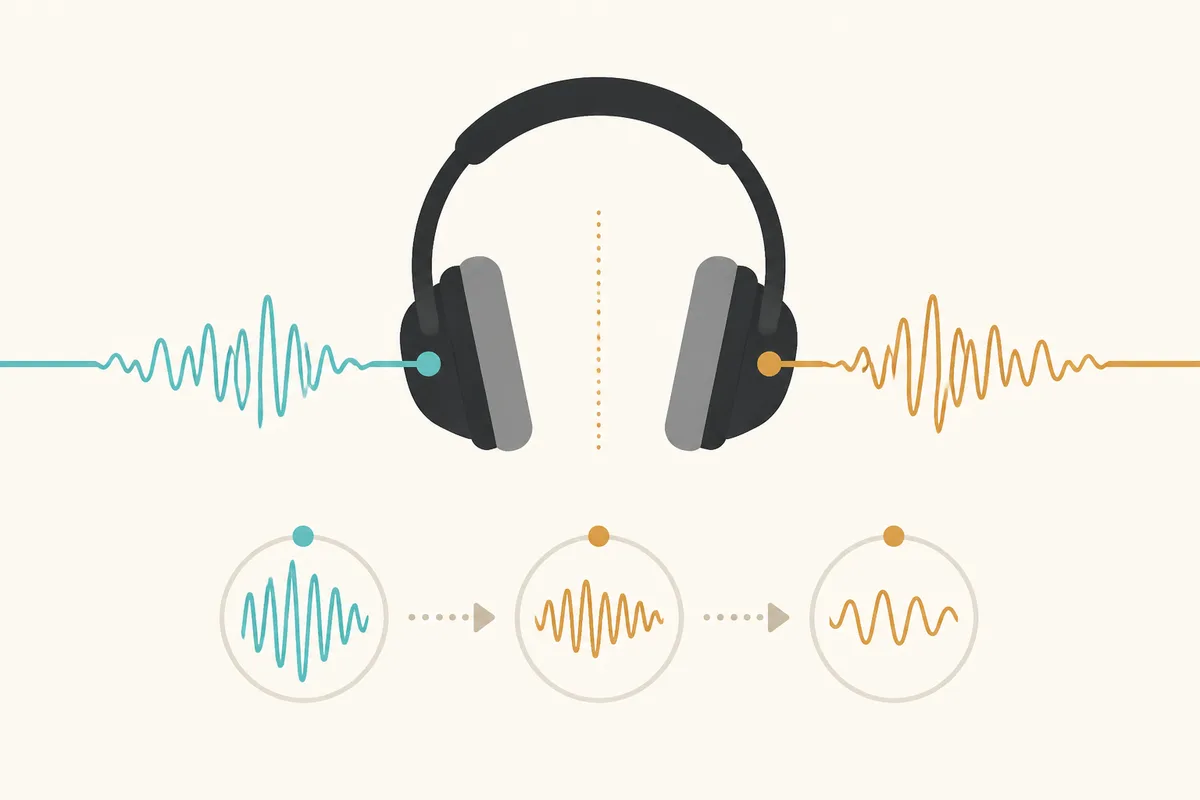
One thing here is unusually clean. Both tones are computed rather than recorded, so the ratio between them is exact whatever plays them. Cheap earbuds and a studio monitor deliver the same gap. A Bluetooth delay ruins the auditory reaction time test and does nothing at all to this one.
What does matter is everything around the sound. A noisy room hides a small gap. A volume set too low does the same. Headphones fix both, which is the only reason this page asks for them.
Hearing changes with age, and it changes unevenly across the range. This page has no age curve to put you on, because nobody has measured enough people this way. Reaction time is the opposite case, and average reaction time by age shows what a curve looks like when the measurements exist. Here, the closest thing to an answer is to run the low, middle and high settings and compare your own three numbers.
What this number is not
This asks how close two clearly audible tones can get. Device volume does not define the result, but speaker quality, room noise and the chosen pitch can still move it.
It is not a musical ability score either. A fine threshold does not make anyone a better player, and a coarse one has never stopped anyone learning an instrument. Rhythm, memory and practice do far more work than this number does, which is part of why keeping time is measured on its own page.
Run this page ten times and your threshold will improve. That improvement is real and it belongs to this task. You have learned what the pair sounds like and where to put your attention. That is worth having, and it is not a change in your hearing.
Questions
What counts as a good result on a tone deaf test?
Most first runs land between 10 and 40 cents, which is a fifth of a piano key or less. Above 100 cents means a whole key was hard to call, and that is worth repeating with headphones before reading anything into it.
Does this tell me whether I am tone deaf?
No. Congenital amusia is uncommon and it is identified with a full battery of listening tasks, not with one gap in cents. This page measures the gap and stops there.
Why am I not told whether each answer was right?
You are, in the only way that matters. The bar narrows when you get two right and widens when you get one wrong, so the gap itself is the feedback.
Do I need headphones?
They help and they are not essential. The pitch of each tone is exact through any speaker. Headphones only fix the noise in your room and the volume in your ears.
Why higher or lower rather than same or different?
Because same or different can be played. Answer different often enough and the score climbs without your ears doing anything. Picking a direction leaves a guess at one in two and nothing better.
Why does the first tone move around?
So you cannot learn it. If every pair started on the same note, you would learn it. You would then judge the second tone against that memory rather than against the tone before it.
My score stopped at 2 cents. What does that mean?
That is the floor of this test, and the card says so when you reach it. Two cents is finer than the best published thresholds, so a run that gets there has run out of room rather than found your limit.
Should I use the low, middle or high setting?
Start in the middle, which is where most published work sits. The other two are worth running afterwards. A gap that is easy in the middle and hard high up is the interesting result here.
Sources
- Peretz I, Champod A-S, Hyde K (2003). Varieties of musical disorders: the Montreal Battery of Evaluation of Amusia. Annals of the New York Academy of Sciences, 999, 58-75. Link
- Hyde KL, Peretz I (2004). Brains that are out of tune but in time. Psychological Science, 15(5), 356-360. Link
- Micheyl C, Delhommeau K, Perrot X, Oxenham AJ (2006). Influence of musical and psychoacoustical training on pitch discrimination. Hearing Research, 219(1-2), 36-47. Link