Tempo Keeper
Tap along with the beat, keep going after it stops, and see how far each tap falls from the expected time.
Settings
Changing one restarts the attempt, and scores set under different settings are not comparable.
Quick start
- 1Pick a beat speed. Walking pace suits most people.
- 2Press start, then watch four beats without tapping.
- 3Join in. Tap the canvas on every beat after that.
- 4Keep tapping when the beat stops. Hold the same speed.
- 5Read your median distance from the beat at the end.
Loading test
Why there is no comparison
Median distance from the beat (ms). Lower is faster. No published distribution exists for this task.
Every other test here draws your score on a bar of published results. This one cannot. Nobody has measured enough people on this task to say what a typical result is, so a bar here would be a picture of a number we made up.
Numbers for this task do circulate. The ones we could find name no study and do not agree with each other. We would rather show you nothing than repeat one of those.
No published distribution, and not CognitiveDrill data either. Nobody has measured this task on a large enough sample to say what a typical result is, so this page shows your number and does not rank it. Our own norm is published once a cohort reaches n = 1,000.
Try next
About this test
Why the beat is drawn and never played
Every other rhythm test you will find online clicks at you. This one does not, and the reason is the number rather than taste.
A browser can tell you when a frame of the page reached the screen. It cannot tell you when a sound left your speakers. Several things sit between the moment a page asks for a click and the moment your ear receives it. The audio buffer, the sound card, any Bluetooth link and the speaker all add a little. That delay is real, it varies from tens of milliseconds to well over a hundred, and no web page can measure it on your machine.
Score a tap against a sound and you fold that unknown delay straight into the result. Everybody would look early by an amount nobody could name. So the beat here fills a ring instead, and the moment the ring is counted from is the frame after the one that painted it. That number the browser does know.
The screen adds a delay of its own, and this page does not pretend otherwise. It is smaller than the audio path, and it is the same on every beat. It moves your whole run by a constant rather than scattering it.
Nearest beat, not last beat
Matching a tap to a beat sounds trivial until you tap slightly early. Imagine a test that only ever compares your tap with the beat that has already happened. A tap arriving 30 ms before the next beat would score as 570 ms late.
This one takes the nearer of the two. Past the halfway point between one beat and the next, your tap is counted as early for the beat still coming. It is not counted as very late for the one gone. That is why the strip under the ring has a centre line with room on both sides of it.
The result of that choice is the offset reading on your card. It keeps its sign. A minus means your taps sat ahead of the beat and a plus means behind it. A number near zero means the two sides cancelled out, not that every tap was perfect.
The headline score throws the sign away and takes the median of the distances. Someone who lands 40 ms early half the time and 40 ms late the rest of it has an offset near zero. Their timing deviation is 40 ms. Those are two different facts about the same run, and the card shows both.
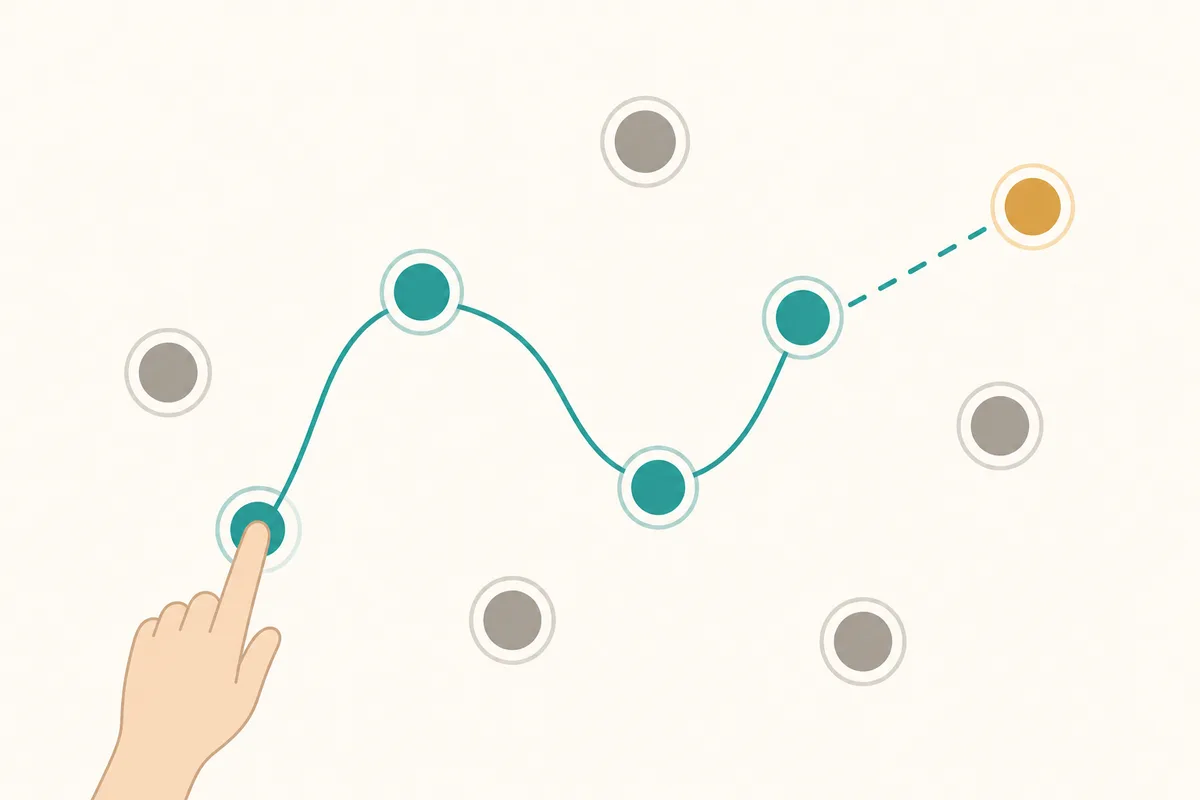
The half of the test with no metronome
Once you have tapped your allotted beats the ring goes quiet and you carry on alone. This half is the one that separates following from keeping.
Following a beat is partly correction. You hear or see where you landed and you nudge the next one. Take the beat away and there is nothing left to correct against, so whatever tempo you were actually holding is the tempo that comes out.
Two readings come from it. Solo tempo is the speed you held once the beat stopped, in beats a minute. Compare it with the setting you chose and you can see which way you drift. Solo wobble is how much your gaps varied around that speed. A person can drift a long way and still be steady, or hold the right average while wandering either side of it.
- Solo tempo above the setting means you sped up once the beat went.
- Solo tempo below it means you slowed down.
- A small wobble with a large drift means you kept a steady tempo, just not the one you were given.
- A large wobble with no drift means you arrived back in the right place by accident.
What a small number here is not
A low timing deviation says your taps landed close to a beat on a screen, on your hardware, today. It is not musical ability or coordination in general. It is a result for this rhythm task.
Practice will move it, and what moves is this task. Getting better at tapping with a ring makes you better at tapping with a ring. That is worth saying plainly, because the wider claim is the one this whole industry keeps making.
The comparison block is empty on purpose. Nobody has published a distribution of how far ordinary people land from a visual beat on their own screens. There is no honest bar to draw. Your own history is shown instead, and it is the only fair comparison available.
If you want a number that does sit against real published data, average reaction time by age is the place to start. It measures a response to something that arrives without warning, which is close to the opposite of what you did here. What counts as a good reaction time explains how much of any such figure belongs to your equipment.
Questions
What is a good timing deviation?
No published distribution exists for this task, so there is no honest cut-off to quote. Most first runs at walking pace land somewhere in the tens of milliseconds. Your own best over several runs is the comparison worth having.
Why does the page not rank my number?
A rank needs a distribution, and nobody has measured this task on a large enough sample to publish one. The laboratory work on tapping uses small trained groups and its own equipment. Drawing a bar from that would give a confident answer to a question nobody has actually asked of the general public.
Is tapping early bad?
It is not scored as worse than tapping late. The headline number ignores the direction and counts only the distance. The offset reading keeps the sign, so you can see which side you sat on. Nothing on the page treats one side as the better one.
Why did the beat stop halfway through?
That is the second half of the test. With the beat running you can correct towards it after every tap. With the beat gone, the tempo you produce is entirely your own, which is what solo tempo and solo wobble describe.
Why were some of my taps dropped?
Two presses arriving less than 100 ms apart are treated as one gesture that bounced rather than two attempts at a beat. Beats here are 500 ms apart at the fastest setting, so nothing deliberate falls foul of it. A second tap aimed at a beat that already has one is dropped for the same reason.
Does my screen refresh rate change the result?
A little. A 60 Hz screen can only show the beat at 16 ms steps, and a 144 Hz screen at 7 ms steps. The beat is counted from the frame that actually painted it, so the effect is a small constant rather than random noise. Comparing your runs on one machine is safe. Comparing across two very different screens is not.
How is this different from the spacebar speed test?
The spacebar test asks how many taps you can produce in a fixed window, and faster is better. This one gives you the speed and asks how accurately you can meet it. Tapping quicker here makes your score worse, not better.
Can I run it with sound instead?
No, and that is deliberate. A browser cannot measure how long a sound takes to reach your ears. Timing your taps against one would add a delay of unknown size to every result. The first section on this page explains the trade in full.