Relative Pitch Test
Listen to two notes from a different starting pitch each time, then identify the musical distance between them.
Settings
Changing one restarts the attempt, and scores set under different settings are not comparable.
Quick start
- 1Put headphones on, or turn your speakers up a little.
- 2Press Start. Two notes play from a starting pitch you have not heard before.
- 3Name the gap between them on the keypad. Each name carries its size in semitones.
- 4Answer when you are ready. There is no clock on a pair.
- 5Keep going to the end. Nothing is marked right or wrong until then.
Loading test
Why there is no comparison
Intervals named correctly (%). Higher is better. No published distribution exists for this task.
Every other test here draws your score on a bar of published results. This one cannot. Nobody has measured enough people on this task to say what a typical result is, so a bar here would be a picture of a number we made up.
Numbers for this task do circulate. The ones we could find name no study and do not agree with each other. We would rather show you nothing than repeat one of those.
No published distribution, and not CognitiveDrill data either. Nobody has measured this task on a large enough sample to say what a typical result is, so this page shows your number and does not rank it. Our own norm is published once a cohort reaches n = 1,000.
Try next
About this test
Naming the gap instead of the note
Play a C and then the E above it. Almost everyone can hear that the second note is higher. Rather fewer can say how much higher, and that is the whole of this test.
The distance between two notes is called an interval, and it has a name. Four semitones up is a major third. Seven is a perfect fifth. Twelve is an octave, the point where the note sounds like the same note again.
Those names are what the keypad offers, with the size in semitones printed under each one. You are not asked to know any theory. You are asked whether the gap you just heard is the same gap you have heard before under that name.
The perfect pitch test asks the opposite question. There a note arrives alone and has to carry its own name. Here the starting note is thrown away, and the distance is all that is left.
Why the starting note moves every time
Every pair starts somewhere new, drawn from two octaves. That is not decoration. It is the one thing that keeps the test honest.
Fix the starting note and the task quietly changes. After a few pairs you would know that note, and naming the second one absolutely would answer every trial without hearing the gap at all. A test with a fixed root measures a mix of two skills and cannot tell you which one you used.
A moving root also blocks the other shortcut, which is holding a reference in your head from a song you know. You can still hum your way to an answer, and plenty of people do. That is genuinely relative pitch, so this page counts it.
Why there is no clock on the answer
The perfect pitch test gives you five seconds and no more. Given longer you can start from a note you know, walk up in steps and count, which is a different skill wearing that test's name.
Counting up in steps is what this test is asking for. Ruling it out would leave almost nothing behind. So there is no deadline here, and the time you take is reported rather than judged.
That second number is worth watching across runs. Two people can name the same share of intervals, one in two seconds and one in ten. The fast answer is recognition. The slow one is arithmetic, and it stops working the moment a tune moves faster than you can count.
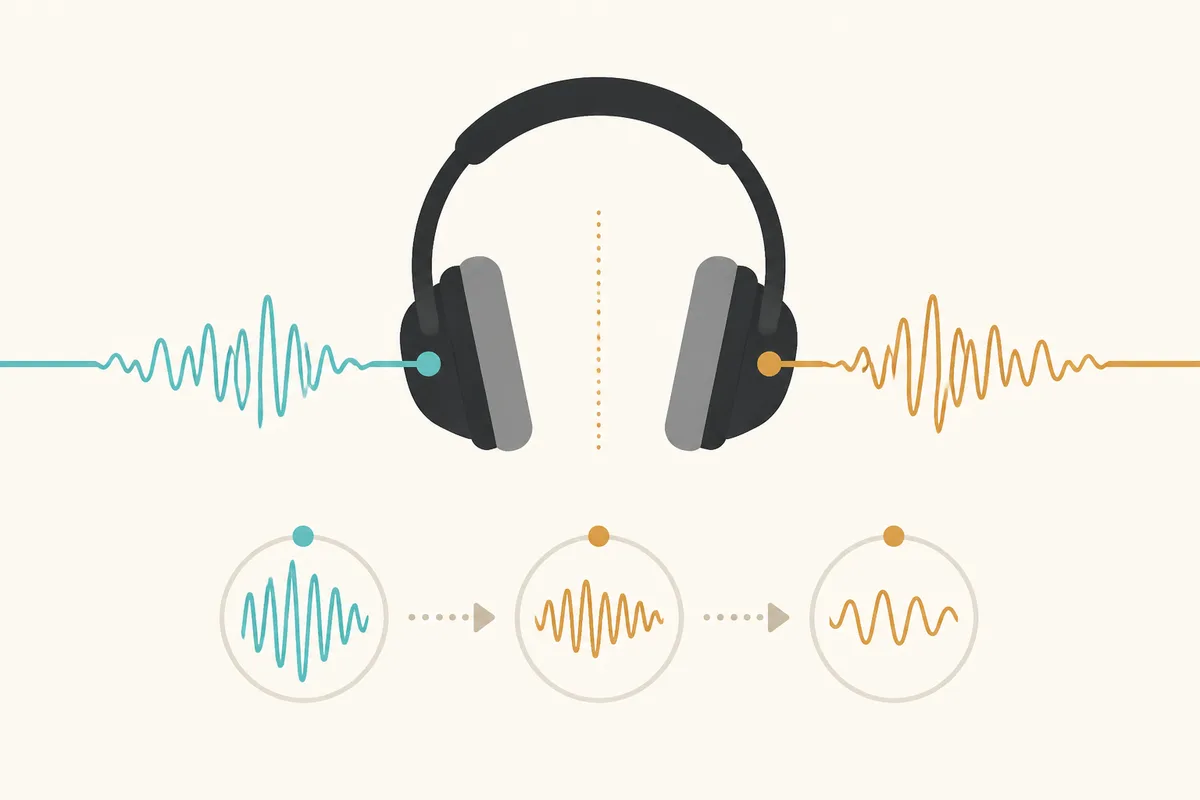
Reading the two numbers
The headline is the share you named exactly right. With all twelve names on the keypad, guessing scores about 8 per cent, so anything near that means the notes did no work. On the major scale setting there are seven names and guessing scores about 14 per cent.
The second figure counts every answer that landed within one semitone of the truth. It matters because the common confusions are neighbours: a major third for a perfect fourth, a minor seventh for a major sixth. A run that is often right and never far wrong is a different result from one that is scattered.
Answers are not marked as you go. Feedback would let you calibrate against the first few pairs and climb. The score would then measure how quickly you learned rather than what you arrived with.
For what a properly measured number looks like, a good digit span has one. Thousands of people have been tested one way, so a percentile there means something. Interval naming has no equivalent, which is why this page shows your figure and does not rank it.
What the browser controls, and what it does not
One part of this is unusually clean. The notes are generated digitally, so the distance between them is exact whatever they come out of. Cheap earbuds do not stretch an interval, and Bluetooth delay, which ruins the auditory reaction time test, does nothing here at all.
What the page cannot control is the room, the volume and the noise around you. It also cannot control the setting you picked. Two notes played together are harder to separate than two played in sequence, so the two settings are two different tests.
It cannot control experience either. Anyone who has done ear training will score far above someone who has not, and that gap is practice rather than hearing.
What this score does not mean
This is not a measure of musical ability. Interval naming is one narrow skill inside music, and plenty of good musicians play by ear and have never named an interval in their lives.
It reports how accurately you named notes in this run. Your headphones, volume and listening environment all affect the result.
Repeated runs will move this number, and it is worth being plain about what that means. You are getting better at naming intervals on a piano sound in a browser. That is a real skill and it is the only thing improving here. A good place to see the same argument made about a much older test is the piece on reaction time.
Questions
What is a good score on a relative pitch test?
Nobody has published a distribution for this task on an untrained sample, so this page will not invent one. Guessing scores about 8 per cent with twelve names. Anything well clear of that means you are hearing the gap.
Do I need to know music theory?
No. Every name on the keypad carries its size in semitones underneath. Answer in numbers of steps if the names mean nothing to you.
Why does the starting note change every pair?
Because a fixed starting note lets you answer by naming the second note absolutely, which is a different skill. A moving root leaves only the distance to go on.
Is this the same as an ear training test?
It is the measuring half of one. Ear training drills intervals with feedback until they stick. This page withholds feedback on purpose, so it reports where you are rather than teaching you.
Why am I not told whether each answer was right?
Feedback lets you calibrate. Learn from the first few pairs and the rest of the run measures how quickly you learned, not what you brought with you.
What does the time per pair tell me?
How you got there. A recognised interval is answered in a second or two. Counting up in steps from a note you know takes far longer, and it is the answer that fails first when music moves quickly.
Why is playing both notes at once harder?
Two notes in sequence give you a before and an after to compare. Played together they blend into one sound, and the gap has to be heard inside that blend rather than across time.
Do I need headphones?
Speakers are fine. The distance between the two notes is exact however they are played, so only the volume and the noise in your room matter.
Sources
- Deutsch D (2013). Absolute pitch. In Deutsch D (ed.), The Psychology of Music, 3rd edition, 141-182. Academic Press. Link
- McDermott JH, Keebler MV, Micheyl C, Oxenham AJ (2010). Musical intervals and relative pitch: frequency resolution, not interval resolution, is special. Journal of the Acoustical Society of America, 128(4), 1943-1951. Link