Hearing Frequency Test
Check the highest frequency your audio setup can reproduce, since your speakers may reach their limit before your ears.
Settings
Changing one restarts the attempt, and scores set under different settings are not comparable.
Quick start
- 1Put headphones on. Speakers are the first thing that runs out here.
- 2Set your system volume where speech is comfortable, then leave it there.
- 3Press Start. Two windows open in turn and a tone hides in one of them.
- 4Say which window held it. Guess if you have to.
- 5Keep going. The tone climbs until a step beats you.
Loading test
Why there is no comparison
Highest tone cleared (kHz). Higher is better. No published distribution exists for this task.
Every other test here draws your score on a bar of published results. This one cannot. Nobody has measured enough people on this task to say what a typical result is, so a bar here would be a picture of a number we made up.
Numbers for this task do circulate. The ones we could find name no study and do not agree with each other. We would rather show you nothing than repeat one of those.
No published distribution, and not CognitiveDrill data either. Nobody has measured this task on a large enough sample to say what a typical result is, so this page shows your number and does not rank it. Our own norm is published once a cohort reaches n = 1,000.
Try next
About this test
This measures your equipment at least as much as your ears
Read the number as a property of the whole chain. That is your headphones, your sound card, your volume setting, the noise in the room, and then your ears. It stops at whichever of those runs out first, and on most setups that is not the ears.
Small speakers and cheap earbuds fall away above 15 kHz. Laptop speakers are usually worse. Some audio drivers quietly filter the top of the range. A Bluetooth codec throws the highest frequencies away on purpose, because almost nothing is heard up there.
A real measurement of hearing is done with calibrated headphones in a quiet booth, and the level arriving at the eardrum is known in decibels. Nothing in a browser knows any of that. So this page reports where your chain stopped and does not translate it into anything about you.
This task reports the highest frequency you located in this run. Headphones, volume and background noise all sit inside the result.
Why you are asked which window, and not whether you heard it
Every other version of this test asks whether you can still hear the tone. That question cannot be answered wrongly. Nobody can check you, so the score measures how willing you are to say yes.
It is worse than it sounds. Play no tone at all and a good share of people still report hearing something. A quiet room is full of small sounds, and expectation fills the rest in.
So the tone hides in one of two windows here and you say which one. Guessing is right half the time and no more. Getting three in a row right by luck happens about 12 per cent of the time. A step is only cleared when every try at it is right.
That is why this run takes longer than the usual sliding tone. The extra minute buys the one thing that makes the number worth reading.
Reading the two numbers
The headline is the highest step where every try was right. That is the conservative figure and it is the one to quote.
The second figure is the highest step where you got anything right at all. It is usually one rung higher, and the gap between the two is the interesting part. A tone at the edge of hearing is not simply absent. It fades into something you catch about half the time, and the two numbers put a bracket around that band.
Steps cleared is the count behind the headline. It moves when you change the starting point, so two runs are only comparable when they started in the same place.
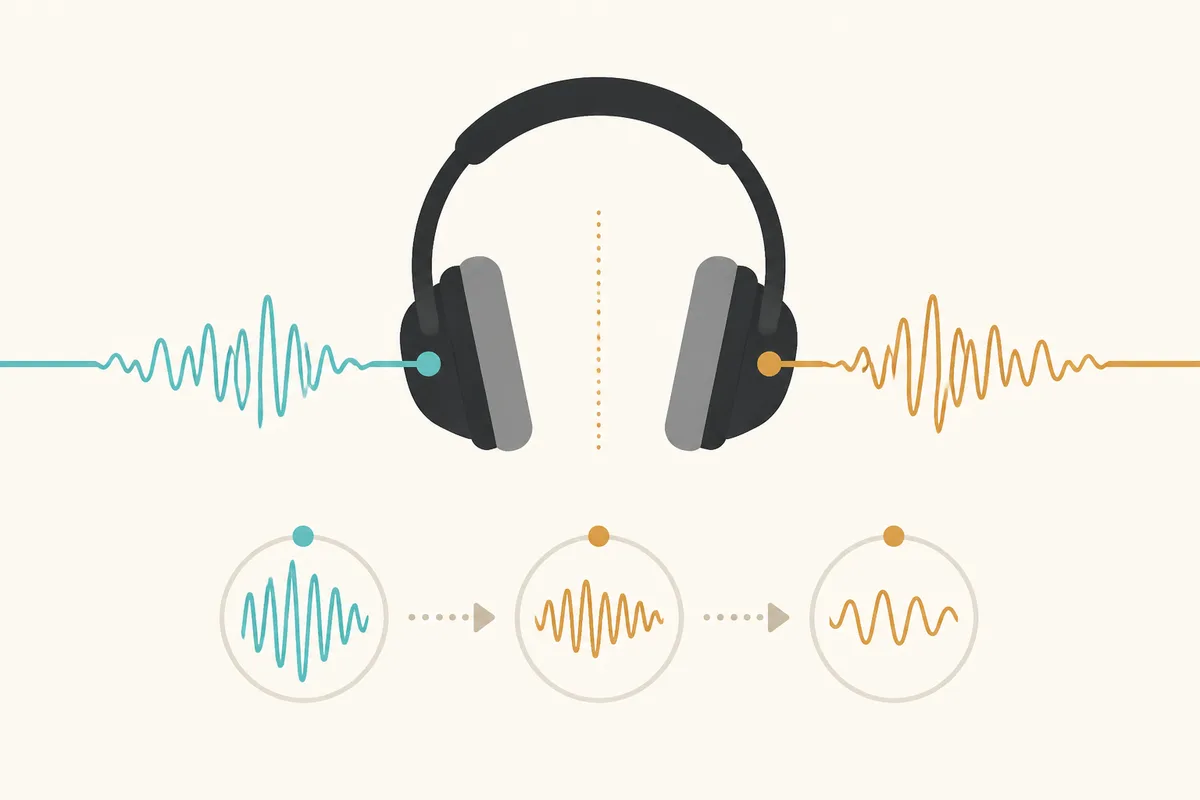
Why the top of the range goes first with age
Hearing at the top of the range declines with age in almost everyone, gradually and from early adulthood. It is the most reliable pattern in the whole of audiology. It is why a teenager and their parent get different numbers on the same speakers.
The inside of the ear works a little like a piano laid out along a coiled tube. High notes are picked up at the near end and low notes deep inside. The cells that handle the top of the range are the ones every loud sound reaches first.
None of that makes the figure here a measure of damage or of age. Age moves a great many measured numbers, and reaction time by age shows what that looks like when the measurement is done properly. Nothing on this page is done properly enough for that comparison.
There is one genuinely useful thing to do with it. Run it twice on the same headphones at the same volume, once now and once in a year. Even that is a rough comparison of the whole chain rather than of your ears.
What a browser cannot know
The frequency of the tone is exact. Everything about how loud it arrives is not, and loudness is what decides whether a tone at the edge is heard.
There is no way to ask your operating system how loud its output is. There is no way to know what your headphones do above 16 kHz. There is no way to hear the room you are sitting in. The volume setting on this page moves the number, which is the clearest possible demonstration of the problem.
Turning it up to chase a higher figure is missing the point twice over. The number is not a score to beat, and a louder tone at the top of the range is not a kindness to your ears.
One thing here is clean, and it is worth saying. The pitch of a tone survives any playback chain intact, which is why the relative pitch test can be trusted where this one cannot. Loudness is the part that does not survive.
What this score does not mean
The result is your highest correctly located frequency on this equipment, at this volume, in this room. Change any of those and the number can change too.
Most of everyday hearing happens far below the frequencies this page explores. Speech lives between roughly 250 Hz and 6 kHz, so someone who clears nothing above 12 kHz here may hear conversation perfectly well.
Practice will not move this number, and there is nothing to train. If you want the version of this argument that applies to the tests that can be trained, the piece on reaction time makes it.
Questions
What is the highest frequency a person can hear?
The range usually quoted is 20 Hz to 20 kHz, and the top of it falls with age from early adulthood onwards. That figure comes from calibrated audiometry, not from a browser, and this page cannot check it.
Why did my score come out lower than I expected?
Almost always the equipment. Earbuds, laptop speakers and Bluetooth all give up on the top of the range before your ears do. A quiet volume setting takes another slice off.
Does a low result mean I have hearing loss?
No. This page records what you heard through your current audio setup; equipment and surroundings shape the result.
Why is a tone hidden in one of two windows?
Because asking whether you heard something has no wrong answer. Hiding the tone means guessing is right half the time and no more, so the result cannot be inflated by saying yes.
Should I turn the volume up?
Set it where speech is comfortable and leave it there. Turning it up raises the number without telling you anything, and a loud tone at the top of the range is not worth chasing.
Do headphones give a different result from speakers?
Usually a much better one. Speakers have to move air across a room and lose the top of the range doing it. Wired headphones sit against your ear and lose less.
Why does the test stop at 20 kHz?
Because almost nothing above that survives the trip. Digital audio at the usual sample rates cannot carry it, most hardware will not reproduce it, and very few adults hear it.
Why did it not even clear the first step?
That is nearly always the volume or the output device rather than your hearing. Check that sound is going where you think it is, then start again.
Sources
- Stelmachowicz PG, Beauchaine KA, Kalberer A, Jesteadt W (1989). Normative thresholds in the 8- to 20-kHz range as a function of age. Journal of the Acoustical Society of America, 86(4), 1384-1391. Link
- Rodriguez Valiente A, Trinidad A, Garcia Berrocal JR, Gorriz C, Ramirez Camacho R (2014). Extended high-frequency (9-20 kHz) audiometry reference thresholds in 645 healthy subjects. International Journal of Audiology, 53(8), 531-545. Link