Sound Localisation Test
Measure how you use the tiny timing difference created because your ears sit about twenty centimetres apart.
Settings
Changing one restarts the attempt, and scores set under different settings are not comparable.
Quick start
- 1Put headphones on. Wired ones if you have a pair.
- 2Press Start. A sound plays in one ear and you say which ear it was.
- 3Listen to the burst. Nothing is timed, so take as long as you like.
- 4Drag the marker round the arc to where you heard it. Arrow keys move it too.
- 5Lock it in. The next burst follows on its own.
Loading test
Why there is no comparison
Median angle error (°). Lower is faster. No published distribution exists for this task.
Every other test here draws your score on a bar of published results. This one cannot. Nobody has measured enough people on this task to say what a typical result is, so a bar here would be a picture of a number we made up.
Numbers for this task do circulate. The ones we could find name no study and do not agree with each other. We would rather show you nothing than repeat one of those.
No published distribution, and not CognitiveDrill data either. Nobody has measured this task on a large enough sample to say what a typical result is, so this page shows your number and does not rank it. Our own norm is published once a cohort reaches n = 1,000.
Try next
About this test
The gap between your ears is the whole cue
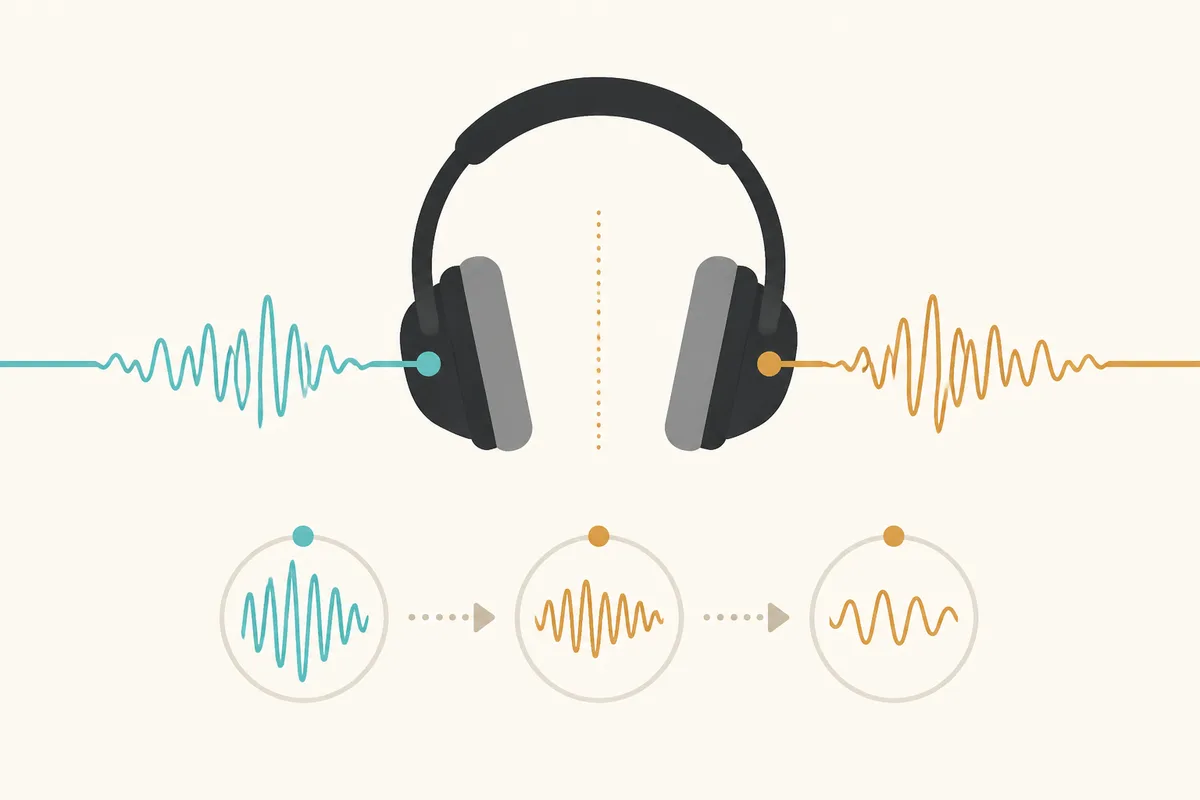
A sound coming from your right reaches your right ear first. Your head is roughly twenty centimetres across, so the far ear waits. At the very edge of the range, straight out to one side, it waits about two thirds of a millisecond.
That is the entire signal. There is nothing else in it. Your brain reads a gap smaller than a thousandth of a second and turns it into a direction. None of that reaches you as effort.
The trained threshold for that gap is around ten millionths of a second, which is roughly one degree of angle near the front. That figure comes from listeners over headphones in a laboratory, doing nothing else, for as long as it took.
This page writes that gap into a stereo buffer by hand. The near channel gets the burst and the far channel gets the same burst shifted. The shift is read between samples, so it lands where it was asked to rather than at the nearest whole one.
Headphones put the sound inside your head
Here is the part most versions of this test do not tell you. Over headphones the sound does not appear out in the room. It appears on a line running through your head, from one ear to the other.
That happens because a real sound in a real room is also shaped by your outer ear, your shoulders and the walls. Headphones skip all of it. What is left is the timing gap, and the timing gap alone puts the sound on a line rather than in a place.
So the degrees on the arc are a translation, and it is worth being blunt about which way it runs. Each angle on the arc is turned into the gap it would produce in the open air. That gap is what you actually hear.
The translation uses a textbook formula for a round head of average size. Your head is not average, and the difference shows up as a small stretch or squash of the whole scale. It moves everyone's number a little and it moves nobody's ranking.
Why the front is sharper than the sides
Half the bursts come from near the front and half from out to the side, and the result card splits them for a reason. Almost everybody is better at the front, often by a factor of five or more.
The reason is in the arithmetic of the gap. Swing a sound ten degrees across the front and the gap changes a lot. Swing it ten degrees at the far edge, where the sound is already almost side on, and the gap barely changes at all.
So the same ears reading the same timing get a sharp answer in one place and a vague one in the other. It is not attention and it is not effort. The information is simply thinner out there.
This is also why a real listener turns their head. A small turn drags a side sound towards the front, where the cue is strong. Two readings from two head positions beat one reading from either. Nothing in a browser can offer you that.
A lean is not the same as a miss
The third figure on the card is your lean. It adds up your errors with their signs kept. Answering to the right of the truth shows as a positive number, and answering to the left shows as a negative one.
A lean and an error are different faults. You can be within five degrees every time and still sit five degrees to one side of every burst. Accuracy is how tightly your answers cluster and lean is where the cluster sits.
A few degrees of lean is ordinary and means very little. It can be your headphones, which are rarely matched perfectly. It can be how they are sitting. It can be the same asymmetry everyone has and never notices.
A large lean means one side was chosen more often in this run. Swap the headphones around and repeat the task: if the lean swaps too, the equipment is the likely source.
There is no bar on this page, and that is the honest answer
Most tests here show you where your number sits among other people. This one does not, because the distribution does not exist.
Localisation has been measured carefully for the better part of a century. All of it was done in the open air, with real loudspeakers, in rooms built to have no echo, with the listener's head held still. The classic paper reports the smallest angle two sources can differ by, which is a different question again.
None of that transfers to a burst in a pair of earbuds, judged on a marked arc in five degree steps. Borrowing those figures would give you a percentile that looked precise and meant nothing. Inventing one is the single thing this site will not do.
So the page reports your number, splits it two ways, and leaves it there. If you want the version of a test that does have a proper distribution behind it, the reaction time article shows what one looks like. For a hearing measure with the same problem, our page on perfect pitch accuracy sets out why that figure is so slippery too.
Why the run will not start until both ears answer
Two sounds play before anything is measured. One goes to the left channel only and one to the right, and you say which ear each landed in.
This is not a formality. If your output is mono, both ears get the same signal and there is no gap to hear. Every answer on the arc would then be a guess. The test would still produce a number, and the number would be noise wearing a decimal point.
Swapped channels are the other trap, and they are more common than you would think. A cable in the wrong socket mirrors the whole test. A mirrored run then looks like a very large lean rather than like a wiring fault.
The order of the two checks is drawn fresh each time, so a setup that fails cannot pass by guessing reliably. Get one wrong and the canvas says so and offers the check again rather than handing you a score.
Questions
Do I need headphones for this test?
Yes, and the test will not start without them. Two speakers in a room send both signals to both ears, which erases the timing gap the whole task depends on.
What is a good score on a sound localisation test?
Nobody can say, and this page will not pretend otherwise. No distribution has been published for this task in this form, so there is no bar and no percentile here.
Why does the sound seem to be inside my head?
Because it is. Headphones give you the timing difference between the ears and none of the shaping a real room adds. Timing on its own places a sound on a line through your head rather than out in the room.
Why am I so much worse at the sides than in the middle?
Because the timing gap changes quickly as a sound moves across the front and slowly once it is already off to one side. Everyone shows this pattern and it is a property of the geometry rather than of you.
Does a lean to one side mean something is wrong with that ear?
Not on its own. Mismatched headphones, how they are seated and ordinary asymmetry all produce a small lean.
Can I get better at this with practice?
Your score will improve for a while as you learn what the arc means and how the bursts sound. That is learning this test, not sharpening your hearing, and the gain stops fairly quickly.
Why is nothing timed here?
Because speed and accuracy would fight each other and the number would mean neither. Where a sound was and how fast you noticed it are separate questions, and the reaction time tests answer the second one.
Does it matter how loud I set it?
Very little, as long as it is comfortable and the same in both ears. The cue is a difference in timing, and timing survives the volume knob in a way that loudness does not.
Sources
- Mills AW (1958). On the minimum audible angle. Journal of the Acoustical Society of America, 30(4), 237-246. Link
- Klumpp RG, Eady HR (1956). Some measurements of interaural time difference thresholds. Journal of the Acoustical Society of America, 28(5), 859-860. Link
- Wightman FL, Kistler DJ (1992). The dominant role of low-frequency interaural time differences in sound localization. Journal of the Acoustical Society of America, 91(3), 1648-1661. Link
- Blauert J (1997). Spatial Hearing: The Psychophysics of Human Sound Localization, revised edition. MIT Press, Cambridge MA. Link